For years I prepared lessons that helped nobody in the room.
Not for lack of work. I worked at the wrong thing. I would sit down with a passage and a deadline and try to show up on the night as something close to a biblical scholar. I was intimidated. I did not have the hours that seemed to require, so I aimed at teaching excellence instead, and excellence meant the lesson being good.
Sometimes it was good. It was also, often, a careful answer to questions nobody there had asked.
That is the part that took me longest to admit. My preparation was not addressing the concerns actually in the room. I was building toward the perfect lesson, and a perfect lesson is a closed object. There is no space in it for what somebody walked in carrying.
I was also not leaving much room for God to speak through me. I had already decided what the hour would be.
Robby Gallaty prints a verse at the top of his own HEAR handout: “Open my eyes, that I may behold wondrous things out of your law.” Psalm 119:18. That is a prayer to be shown something. It is not a plan to produce something. Those are different jobs, and for years I was doing the second one and calling it the first.
What HEAR actually is
Four steps: Highlight, Explain, Apply, Respond. Robby and Kandi Gallaty built it. You pray, read a passage, and write four short entries. Fifteen minutes.
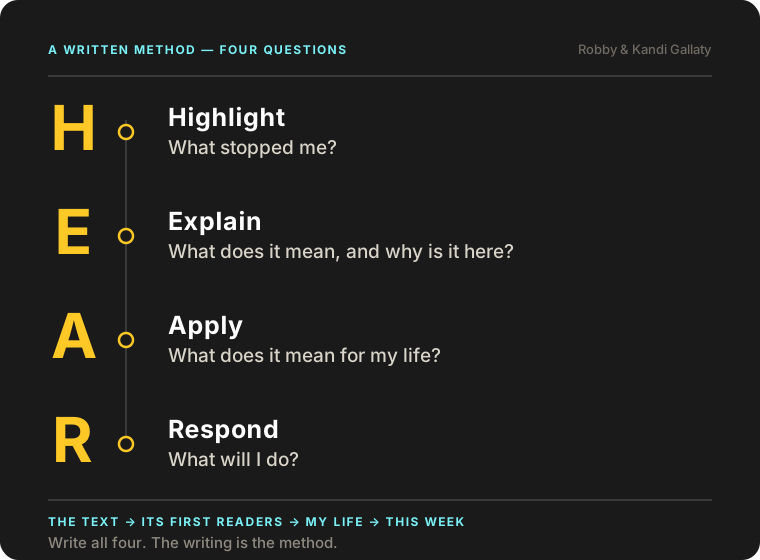
Four letters, four questions. If you keep nothing else from this post, keep the questions. They are the whole method, and you can run them on any passage without preparing a thing.
Highlight. Write out the one or two verses that stopped you. Not the ones you were supposed to notice — the ones that actually did. Add the book, chapter and verse, and give the entry a title so you can find it again next year.
Explain. What does this mean, and why is it here? More on this one below, because it is the step I got wrong for a decade.
Apply. What does this teach me about God, and what would it look like in my life? Two to five sentences. Gallaty calls this “the heart of the process,” where everything else culminates. He is right.
Respond. An action, a change, or a prayer written out. His instruction is four words: be specific, and carry it out.
The E is not the scholarly part
I avoided Explain for years because the name told me what it was. Explain. Produce an explanation. That is precisely the posture I was already failing at.
Then I read what Gallaty actually wrote about it. His instruction is to “engage with the text and wrestle for its meaning,” by “prayerfully leaning on the help of the Holy Spirit.”
Wrestle. Not present. Not perform.
And look at the questions he puts underneath. Two are what you would expect — why was this written, to whom, how does it sit with the verses around it. The other two are not about the author at all:
- Why did the Holy Spirit include this passage in the book?
- What is He intending to communicate through this text?
You cannot study your way to those. You can only ask them and wait. The step I was most afraid of is the one place in the whole method where the instruction is to stop working and lean.
The ordinary questions are also easier than I assumed. Take 1 Peter 1:1. Peter writes to believers scattered across five provinces, a long way from anywhere that counted as the centre. Translations render his phrase for them differently — some say elect exiles, others land closer to temporarily residing abroad. Read those side by side and the letter shifts. He is not writing to headquarters. He is writing to people at a distance who suspect the distance makes them lesser.
I did not need Greek for that. I needed thirty seconds and a translation that showed its work.
But won’t people get it wrong?
This is the fair criticism of HEAR, and I want to answer it rather than skip it. Give four people a passage and no training and somebody will land somewhere strange. The usual objection is that a method like this leaves people dependent on a facilitator to catch the errors.
Here is the thing. That dependency is the disease, not the cure. It describes my old room exactly — one prepared person at the front, everyone else receiving, and the quality of the hour capped by how much time that person had that week.
So do Explain together. Six people wrestling with the same passage correct each other, out loud, and because it is written down the reasoning is visible instead of vague. Someone’s question about the first readers exposes an assumption the rest of us were carrying. That is not a weaker safeguard than my preparation was. It is a stronger one, and it does not collapse when I have a bad week.
What changed when I stopped lecturing
The move that made the difference is almost embarrassingly simple. I stopped arriving with the lesson and started asking what people highlighted.
Five people read the same passage and five different verses stop them. That is not one talk cut into five pieces. Those are five real doors into the text, and four of them I would never have found. More to the point, they tell me what is actually in the room. Somebody highlights a verse about fear, and now I know something I could not have prepared for.
The questions I used to miss were never hidden. Nothing in the format let them surface. A lesson does not ask. A Highlight does.
Doing this when the room is a thread
If you lead at a distance, you have a harder version of my old problem. You cannot read the room, because there is no room. No faces, no pause, nobody shifting in a chair.
Which makes a written method an advantage rather than a workaround. Ask six people in four timezones to post their Highlight and you get something a physical room rarely gives you: everybody contributes, including the ones who would never speak up. It needs a passage and somewhere to type.
Peter was writing letters to churches he could not be present with, doing real pastoral work at range, and nobody files that under second best. The fuller case for that is in the guide on digital discipleship for churches.
Start this week
Take one passage. Four headings on a page: H, E, A, R — the four questions above, in order. Fifteen minutes, on your own, before you lead anything.
Then the harder half. Next time you gather your group — in a room, on a call, in a thread — do not bring the lesson. Ask what they highlighted, and build the hour out of their answers.
It will feel underprepared. It is not. You spent fifteen minutes in the text and you are about to spend the hour on the actual people, which is more preparation than the perfect lesson ever was.
This is part of the Digital Discipleship edge. The full guide is Digital discipleship for churches.