⌕
JR
Jeff Reed
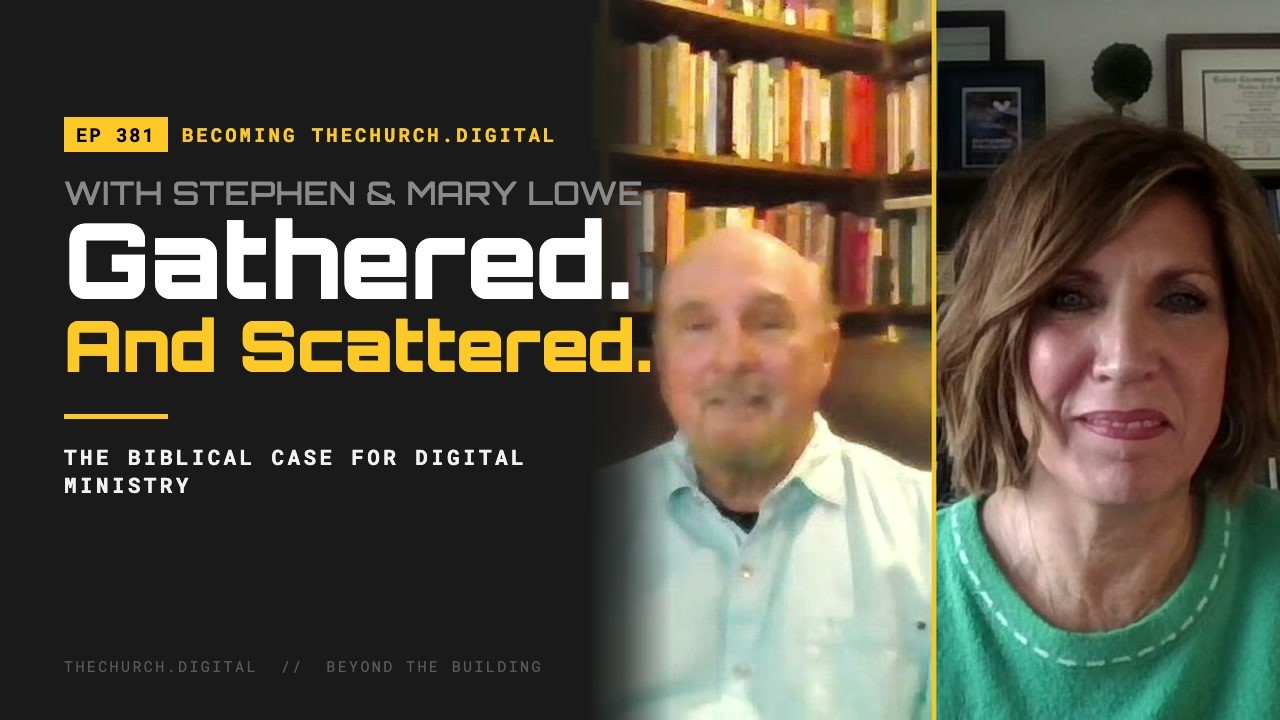
All right, hey, everybody. Welcome to Becoming the Church Digital, episode 381.
SL
Steve Lowe
Thank you.
JR
Jeff Reed
Actually, it was funny, I just did an AI scan today, going over the past 381 episodes of The Church Digital, trying to find topics I hadn't talked about recently and holes and gaps. of what was going on. And that's a whole other conversation into itself. But really, really excited about this conversation today as we're talking about the digital ministry and maybe some of the academia surrounding that. We've got two very special guests coming up right around the corner. Man, one of the coolest things I feel like we're doing right now as a ministry, and it was funny, I was the most hesitant to go into it.
JR
Jeff Reed
This is always the way it is doing digital. You know, the ideas that you pour all your mind space into, eh. But it's the gamble. It's the thing that it's like, you know, I don't know if it's going to work, but let's just give it a shot and see what happens. Those are the ones that always seem to be the thing that works the best, right? And so we're in the midst of doing that right now, and it's called Scattered.
JR
Jeff Reed
It's an online Bible study. I'm sure we're going to talk about it here in the stream, but it's a Bible study. We meet live Tuesday at, what, 5 p.m. Eastern, I think. on Twitch. Leighton, we decided we were going to do it kind of at the Twitch gaming crowd, and Leighton's leading out in that space. So it's Leighton, Ian, I, and just honestly a rotating door of Twitch streamers and gamers and digital missionaries that are in that space.
JR
Jeff Reed
And we're going over the scripture of 1 Peter. Peter's letter to many of the churches that were dispersed, that were scattered up among the region there, going all the way back to Stephen's persecution, Stephen's murder years earlier. And, you know, Dr. Lowe, I'm sure we're going to, Dr. Lowe's, Dr. and Dr. Lowe, I'm sure we can get into this. And biblically, I am looking forward to being corrected multiple times in the stream, I'm sure. But the fact is, is that when you get people together to study Scripture and discuss, not only to explain what the Scripture means to them, highlight what's going on, explain what the Scripture means to them, apply what's going on to their lives, and then talk about what God is challenging them to do and how they're going to respond. Man, only good stuff can come from that.
JR
Jeff Reed
And we've got the Bible study right now, which is creating other content, daily devotionals and things. We've got maybe 50, 60 people globally going through the study with us right now. And that's where we can track a lot of this. In many ways with digital, it's being distributed in ways that aren't that easy to track. And so definitely excited about the road ahead. And even as we're looking into 27, man, I can't believe we're already saying 2027.
JR
Jeff Reed
Listen, if Home Depot bypassed Halloween, if Home Depot bypassed Thanksgiving and is now already trying to sell me on Christmas, yeah, 2027 is right around the corner. And what that holds for us as digital missionaries, it's an exciting season ahead for TCD. and beyond. So, hey, let's go ahead and let's get into this. Let me push the magic button here and bring on Dr. and Dr. Lowe into the conversation. Dr. Stephen Lowe and Dr. Mary Lowe, both faculty at Liberty University.
JR
Jeff Reed
Is that the correct title? Faculty? How do you describe what you do, what your role is over at faculty other than boss?
SL
Steve Lowe
Yeah, we're both faculty. Mary also has administrative duties on top of the faculty duties. Since my semi-retirement two years ago, I just do teaching. So, yeah, we're both there.
JR
Jeff Reed
Just so, just teaching. You've simplified your life and oh, somewhere along the way, I think just yesterday, right, came out with a new book, Biblical Foundations for an Ecology of Digital Ministry by Dr. and Dr. Stephen and Mary Lowe.
SL
Steve Lowe
Right.
JR
Jeff Reed
So, I mean, just so many questions. Why a book? What's the role of digital and physical? Why someone in the retirement age has backed the idea of digital ministry? Like, I don't even know where to start with this.
SL
Steve Lowe
Bye.
JR
Jeff Reed
So tell me your stories, because you're not, I mean, you've been doing ministry before digital. What was your life? What was your life maybe before some of the digital impetus started coming around? And then I know you over the years have really become a proponent of digital. What was maybe some of the catalyst that brought about that change in your own personal life?
SL
Steve Lowe
Well, we were both part of traditional institutions from the inception of our academic careers. So we were doing the typical residential courses, degree programs. At one seminary we were at, they had extension sites, extension campuses. And so we would do those. Sometimes we would do those through video, but mostly there in person. And eventually we got involved in online education.
SL
Steve Lowe
And that really kind of tipped the scales for us in terms of thinking outside of the traditional residential campus courses kind of mindset and began to think more broadly about how education can be delivered through all kinds of different technological means.
ML
Mary Lowe
Thank you.
SL
Steve Lowe
And so back in 1998, I guess it was, we started working to create an online seminary program for Erskine Theological Seminary in South Carolina. And that began a whole new career in terms of online education. We received a grant from the Lilly Foundation and the Wabash Center to do a three-year study on the relationship between online theological education and spiritual formation. That created a lot of published articles.
SL
Steve Lowe
It led to a three-year national consultation. And then eventually the publication of our first book, Ecologies of Faith in the Digital Age. And that was kind of what put us on the map in terms of online education. And then in 2019, I think it was, Mary, we started looking at our own curriculum at Liberty to see whether or not What we were offering in seminary and graduate education had a online or digital component to it that was preparing students for future ministry in that environment. And we had nothing.
SL
Steve Lowe
So we started to create these courses in digital ministry. And in 2020, we launched Cognate in digital ministry. It had four courses in it. And the first thing we noticed in the foundational course was, there wasn't a book anywhere on the market that dealt with biblical theological foundations of digital ministry so that's when we decided to write the book ourselves and that's what you see now right yeah just released yesterday yeah
JR
Jeff Reed
Very cool. And so this came out yesterday, right? Like Tuesday, just recently, sometime this week?
ML
Mary Lowe
Yeah, I think it was yesterday. Yeah.
JR
Jeff Reed
Awesome. And it's Biblical Foundations for an Ecology of Digital Ministry. So the book you wrote previous to this was more about faith towards an individual, and then this gets more towards pastoring, leading, and discipling at a church-level context. Is that right?
ML
Mary Lowe
Yeah, I think that's what you see primarily with the first book was looking at that individual, that process of formation. How do we grow, develop, transform, certainly individually, but within the body of Christ, and then looking at how that happens in digital spaces, online spaces.
JR
Jeff Reed
Mm hmm.
ML
Mary Lowe
And then this book kind of stays with that ecology theme and motif in terms of looking at those connections and interactions that we address in that first book, but playing that out more with digital ministry in various forms.
JR
Jeff Reed
Sure. So as you're watching, if you've got questions, feel free to put them in chat. We'd love to put them up and talk through as we're talking with Dr. Lowe and Dr. Lowe on this. How'd you guys meet to go way off topic? Like what's your background story? How'd you get married?
JR
Jeff Reed
Was it doctor and doctor before or after? Like how do two people become doctors who are married to each other and do ministry together like at the same place?
SL
Steve Lowe
Yeah, we started out at the University of Arkansas, where I was part of the student services program. And Mary was working on a master's degree in adult education and also serving as a head of a residence hall. Our paths crossed and eventually over a period of a couple of two or three years, we were married and began serving a very small institution in Indiana that did all of their education online through CompuServe at that time. Takes you back to the old days, like 1995, 96.
JR
Jeff Reed
Oh, wow. Yeah.
SL
Steve Lowe
where all the communication was keyboarding. You didn't do it through video or even audio because the infrastructure really wasn't in place for that. So we did that for a number of years and started putting together a set of materials for helping students get oriented to learning in an online distance education environment. And fortunately for us, we both had, because of our University of Arkansas connections, had met Dr. Malcolm Knowles, who most people know as the father of American adult education. He had been around for 40 years.
SL
Steve Lowe
He was in retirement at that point because his son was on the faculty at U of A. So we began collaborating with him on some of our projects, and he was very influential and very supportive and encouraging in helping us put these materials together to help adult students figure out how to navigate this new environment called online or distance education and that kind of moved us into academic environments seminary environments and eventually we ended up at liberty about 12 years ago we've been here since 2015 and that universe has just expanded because of you know the reach that liberty has
JR
Jeff Reed
Yeah.
ML
Mary Lowe
interestingly when my my mom and dad went to the mission field in the 60s my dad started in what was really an earlier form of online education back then it was called theological education by extension t for a lot of people where he would take the classroom class content out to the remote rural areas for pastors to study in their contexts in their ministry so they remained in context with that ministry And then, you know, he'd come back home on the weekends and grade. So, you know, dad was involved in those kinds of things way back when, when we get different forms of education by extension.
JR
Jeff Reed
Yeah. Remote learning is something, even today, we just seem to talk a lot, we're talking with churches, paralleling remote learning and long-distance learning, long-distance relationships, that level of things to the work that we're doing alongside churches and with churches.
SL
Steve Lowe
Uh-huh.
JR
Jeff Reed
I'll be honest, I don't know... Dr. Lowe's. I don't know what the temperature level is for digital ministry within the classes that you're teaching and things like that. I don't want to use the word hostile, but... There's not a lot of church support. It's interesting.
SL
Steve Lowe
Right.
JR
Jeff Reed
Even minutes before we did the stream, I was on our Discord channel, and somebody quotes, William Carey, a famous missionary, said to the church, I will go down to the heathen and take them the gospel, but you must hold the rope for me. And then the person says this in Discord. For digital missionaries who do not have a community like TCD... How can they carry on without prayers of the body? In the first church, disciples prayed for one another before going out and during the kingdom work. It basically is painting the picture that it's kind of lonely.
JR
Jeff Reed
And actually, this Bible study that we're doing, Scattered, through first period, it's really the reason we chose 1 Peter, is because Peter's talking to these...
SL
Steve Lowe
Thank you.
JR
Jeff Reed
these disconnected Christians, these isolated Christians that are doing ministry in their context as best as they can, but they're isolated. They're separated from the church in Jerusalem at the time. That's a long question. I want to hone in on it, but what's the temperature check inside the seminaries? Is this next wave of students, are they pro-digital? Are they anti-digital?
JR
Jeff Reed
What are you seeing as you're working with students moving forward?
SL
Steve Lowe
Well, across the younger generations, we get more openness to it.
ML
Mary Lowe
the things go ahead
JR
Jeff Reed
Go ahead. Go ahead, Steven.
SL
Steve Lowe
We have some resistance from our faculty colleagues who have been raised and trained and nurtured in traditional physical church environments. So for them to think about church outside of those structures is kind of difficult for them but younger generations have been raised in that environment and they have latched onto it and they really don't have much of an issue with it in terms of the practical realities of it i think our seminary students raised the notch a little bit in terms of their concern about biblical and theological issues ecclesiology you know doctrine of the church How can you have a church if you're not all together in the same location? So those kinds of issues do pop up.
JR
Jeff Reed
Mary, were you going to say something or add to that?
ML
Mary Lowe
Yeah, I was just going to say, there's a sense in which there's probably a blurring of the lines. And you see that in the way that we live our lives, right? We check the temperature of the house with our phones. We check the oven to see if it's on by our phones. So we're living in a bit of a world where you're blurring the lines in a way that can be helpful. So when we look at seminary education, That's similar to what we're seeing, that they're not stepping out of real life and into a virtual life.
ML
Mary Lowe
Their virtual worlds are part of their real life and vice versa. In fact, that language, I think, is even a misnomer that we talk about real life somehow differently from virtual life. And I think that's probably a less helpful way. to look at the issues, we are just doing digital stuff and non-digital stuff in all of our lives. So we step in and out of those contexts pretty fluidly. And that's what we're seeing with a lot of our seminary students.
ML
Mary Lowe
And I think they often say, what's the big deal? Why are we having these conversations? We thought that that was so yesterday. And so they're looking at other kinds of conversations, how to be more... be pragmatic how can we take digital to a world where maybe there are not as many access points so they're looking at things a little bit differently than maybe what they were five ten years ago yeah
JR
Jeff Reed
Yeah. I mean, there's definitely been a lot of curves on the road over the past five to ten years in ministry.
SL
Steve Lowe
Oh, yeah.
JR
Jeff Reed
You know, COVID amplified the digital conversation. Now it's artificial intelligence and transhumanism and, you know, so many other things in that thread, in that ecosystem that it's like, I don't... I don't know that today's church has really good answers for these things, or maybe they're not comfortable addressing.
JR
Jeff Reed
This isn't unofficial. Let's call it uninformed. This is an uninformed theory I've been working on. And I would love the two of you to maybe help put some intelligent words on this. To me, it seems like the church, the ecclesia, the gathering, is the heartbeat and the holder of the theology. the ecclesia, the gathering, is also the heart of traditionalism.
JR
Jeff Reed
It's not the way my church is. They're allergic, they're adverse to change. I don't want to come across, I'm not bitter, I don't mean this to be strong words, but if you look in the grand scheme of things, the church doesn't like to change and they don't want to experiment.
SL
Steve Lowe
Bye.
JR
Jeff Reed
They have a standard and they want to, as a general rule, they want to hold that standard. And then you have maybe the opposite side, to me it feels like, which is not the gathering, but it's the scattering, the dispersion, those that were dispersed, the early Christians in 1 Peter, in their context, the ones that were away from the church. Now I'm talking about missional cultural, digital missionaries. I'm talking about the mindset, anything short of sin, as long as it gets somebody to understand Jesus, and that's to quote Craig Groeschel. Like there's, as much as do anything and everything, forget the standards.
JR
Jeff Reed
But that's not a church mindset. That's a missionary mindset. That's how missionaries think. That's not how churches are. It's one of the reasons why people that are connected to the church digital... We kind of gave up working with churches years ago because there wasn't much connection because they think we're crazy.
JR
Jeff Reed
But when we start hanging around missionary cultures and organizations that are used to doing things missionally, those are our people.
SL
Steve Lowe
Right.
JR
Jeff Reed
Like that's because we're aligned in the same values. Is there any value? Is there any truth to this idea of churches kind of hold that traditional values? Like is that grounded in scripture or is that grounded in logic from an academia standpoint? Or am I just crazy?
SL
Steve Lowe
Well, it's interesting when you go back to 1900. Adolf Harnack, he was a German theologian, wrote a book entitled The Primitive Church, where he looked at the first three centuries of the church and did a deep dive on what it was like and what they did and all the characteristics of the church. And his conclusion was that it was innovative and always open to change.
SL
Steve Lowe
What had happened between then and now Because the mindset of most churches today is totally different from that.
JR
Jeff Reed
Right.
SL
Steve Lowe
And there is no way that you can kind of match those two things up in your mind. And that's the frustration, I think, is because when you look at the New Testament church in the book of Acts, they're open to the Spirit. And wherever the Spirit is moving them, that's where they're going to go. and they kind of go with the ebb and flow of what's happening in their lives, whether that's gathering in Jerusalem or scattered birth persecution or regathering again later on in Antioch, whatever is happening, they're moving with that. They're agile, they're flexible, and they're just working with the reality as they're facing it. They haven't locked y'all on any particular forms.
SL
Steve Lowe
That's the reason why in our chapter on baptism in the Lord's Supper, we don't nail anything down in terms of what we think ought to be the case in terms of digital ministry versus traditional church ministry in those regards, because in the first three centuries of the church, they couldn't decide either. Those subjects were all over the map. There was no agreement. There is no New Testament doctrine of baptism because there are just too many variations on it.
JR
Jeff Reed
Right.
SL
Steve Lowe
And there is no New Testament doctrine of the Lord's Supper because they practiced it in a lot of different ways. So I think we've got to help churches understand that that's our history. And if we approach it from that perspective and add on top of that a missional perspective that's driving us outward from where we are to expand the kingdom, then I think it's easier for them to accept that reality. But they struggle with it.
JR
Jeff Reed
How do we, how do I, I'm going to own this statement. How do I have conversations with someone? I totally want to get into the book. Sorry, I kind of just derailed this conversation.
SL
Steve Lowe
you
JR
Jeff Reed
How do I have a conversation with someone who is locked into their ideology, their, you know, I don't know whether it's grounded in theology or grounded in extra-biblical opinions. You know, time will tell, and really the Lord only knows that. But, like... How do you start a conversation and how do you segue, not even to convince them, but just to have an open mind meld? Because to me, the conversations come across very grounded and stabilized, like almost...
JR
Jeff Reed
Yeah, almost dismissive before I even start the conversation.
SL
Steve Lowe
All right.
JR
Jeff Reed
Do you advise for those that are stuck in that position that have, is there an opportunity to change minds like you do with the book? Is there an opportunity to let it go? What would you advise for some of us that are on that front line? that are, like my friend is saying, doesn't have a support system. They're leaning to their church to maybe help, but their church doesn't understand.
ML
Mary Lowe
I.
JR
Jeff Reed
Like, do you advise that person that I read from the Discord? Do they give up and find support systems somewhere else? Do they try to convince the church? Like, what do you think we should do?
SL
Steve Lowe
Well, the common ground that we operate on is our high view of scripture. And we find this with our students who come into our classes when we're talking about this, and they come out of traditional backgrounds, traditional churches. All they can think about is physical church environment. That's church as they know it. And when we present the biblical evidence to them, and we're making our case from the scriptures, not from our denominational heritage or theological tradition, but from the text itself, that has a compelling influence on them.
SL
Steve Lowe
And that's the reason why we wrote the book is because that's the group we're trying to reach are those folks that are committed to the scriptures. They want to be faithful to the Lord and to the word of God, but they haven't been taught or they haven't looked very carefully at that text to realize that it has something current to say, about our particular situation when it applies to digital church ministry in any form.
JR
Jeff Reed
Yeah. Mary, what are we going to add to that?
ML
Mary Lowe
I think the reality, well, I think probably the reality too is we aren't going to change some minds. But one of the things we've probably have found most effective is telling your story. I think that never gets old is sharing your story or having other people share your story for you is even more effective. there's a sense in which people will resonate with you telling your story of how you met somebody online or that you were ministered to online, that you couldn't get to church or that you couldn't meet those spaces, but that you have continued to see jesus that you've continued to experience the love of the virtual body of christ that that people continue to meet you on that road where you are and that is probably one of the things we found most effective you know stories like deanna thompson who talks about that virtual body of christ and the way in which she experienced not just physical healing through the prayers and intersections on her behalf but the ways in which people all around the world reached out to and there's the sense of kind of mental emotional whole person healing through that.
ML
Mary Lowe
So I think we can't undersell that value of story, the narrative that we share, and being willing to bring other people into that process of telling stories. And then maybe like your friend who was posting, there's a sense in which you probably want to find other contexts that
JR
Jeff Reed
Yeah.
ML
Mary Lowe
continuing to throw that net out there and there aren't any fish, maybe we throw it on the other side of the boat. Maybe that there are other places where you find openness and you find people who need to hear the gospel. Again, I think a lot of folks that I'm running into are much more pragmatic. How can we get this done? I think there's value in stepping back and saying, all right, what's the theological and biblical rationale and foundation for this? But then ultimately, okay, what do we need to do to move this thing forward?
JR
Jeff Reed
Yeah. At a personal level, I look at, you know, we're talking about remote learning, some of your background starting out. You know, I look at Paul and when he was writing letters to the Corinthians, like he preferred writing rather than visiting. Sometimes it was because he wasn't able to go because he was in prison or situations, and sometimes he just wasn't able to go. It was easier to send letters. Peter, and how Peter was writing to the people in the region with 1 Peter as well.
JR
Jeff Reed
There's a lot of long distance that's implied. When we have conversations with churches, though, you have to breathe the same air molecules. You have to be together. The Bible calls us, and it's funny, they quote, don't forsake the gathering, which is actually the same verse that we as digital missionaries and digital churches, we use. We're not forsaking the gathering.
SL
Steve Lowe
Yeah. Go ahead.
JR
Jeff Reed
We're extending the gathering into digital spaces.
ML
Mary Lowe
Thank you.
JR
Jeff Reed
You know, it was funny, like, if you have a conversation with anybody in our spaces, somebody within 10 minutes will say at some point, like, Paul's not going to use the internet to connect with churches if Paul was alive today. Like, it's almost, like, laughable that this is even a conversation point, but we're still in the same system of... having to validate whether it's working or not. Um, which is a, I mean, for me, it's a pain point. I've been doing this 20 some years. I get it.
JR
Jeff Reed
But at some point you want, you want to see fruit. I can show you trees. And the beauty is, you know, uh, it's not, it's not fruit that's growing on my tree. It's fruit that we've been able to grow on other people's trees and that we've been able to train it and multiply as, as a result of it. Um, In context of where we are as a church, as leadership, is it waiting for the next generation?
JR
Jeff Reed
What does the next five or ten years look like for us in this? Is it waiting for the one generation to retire off and the next to pick up? Is it... coming together in more of these books written, targeting academia realms and trickle down from there? What do you see happening over the next decade?
SL
Steve Lowe
Well, I'm hopeful that the work that you and others have done and what we're trying to contribute to in our little slice of an academic perspective on it, a biblical perspective, will bear some fruit and result in a greater appreciation for the kinds of work that folks like you are doing in digital and virtual spaces. For us, It's not a pragmatic issue. It isn't a matter if it works.
JR
Jeff Reed
Hmm.
SL
Steve Lowe
The more important question is, does it fit? Does it fit the mission of God? Does it fit the mission of the church? Is it in line with what God has called us to be and to do, what Christ has commissioned us to do in the Great Commission? And if it is, then it's legitimate. It's authentic.
SL
Steve Lowe
it's all right for us to be doing it that's the reason why we have that chapter 2 entitled digital church is missional church because we see it as fitting into a larger biblical pattern that had its origin with abraham you go back to abraham isaac and jacob all three of them made a concerted effort to communicate the truth of god to the
ML
Mary Lowe
you
JR
Jeff Reed
Mm hmm.
SL
Steve Lowe
gentile pagan inhabitants of their land and they did that by using communication techniques that those inhabitants could understand which was building altars all over the land and standing at those altars and making proclamation about god to the gentile inhabitants of the land and when you get to the new testament jesus isn't staying in jerusalem he is going first to the lost sheep of the house of Israel, but he's also at the same time making forays into Gentile territories. When he said, I only go to the lost sheep of the house of Israel, he said that in Tyre and Sidon. He said that to the Syrophoenician woman, the Canaanite woman. He wasn't in the land of Israel when he said that. He was out of the land of Israel.
SL
Steve Lowe
So he's in Tyre, he's in Sidon, he's in Samaria, he's in Decapolis. And he has that encounter with the maniac of Decapolis,
JR
Jeff Reed
Sure.
SL
Steve Lowe
demon possessed. Those are territories that are outside of the purview of the folks in Jerusalem. That was not on their map. And yet Jesus is always pushing them and his disciples to widen that perspective so that just like Abraham and Isaac and Jacob planted altars in the land of Canaan, we can plant digital altars in digital spaces that are going to be consistent with the mission that Abraham started and which still exists as far as Christ is concerned.
JR
Jeff Reed
Yeah. I love this. You mentioned the maniac legion, the legion of demons cast out into the sheep and the sheep run off the hill.
SL
Steve Lowe
Right.
JR
Jeff Reed
And, you know, the after story on that is incredible. And it's taken me some years of reading to catch on where the guy wanted to go with Jesus. You changed my life. You got the demons out of me. Where are we going? I'm all in.
JR
Jeff Reed
And Jesus was like, no, you're not following me. You're going over to Decapolis, this ten-city region over here that doesn't have anyone.
SL
Steve Lowe
Yep.
JR
Jeff Reed
Your job is Decapolis. It's nice that you want to sit at the master's feet and become like one of the twelve, but God's got another calling for you. And in this context, that calling is... separation like he is um he is scattered because he's going someplace where he doesn't have a support system where he doesn't have he's not connected to god in the in the literal sense where he's not sitting and following jesus he's he's being separated from that uh we see those same patterns it was interesting we were talking about um yesterday in scripture As we were looking at 1 Peter, we were talking about Jesus as the cornerstone. And it says, you know, the stone the builders rejected has become the cornerstone.
JR
Jeff Reed
He was rejected.
SL
Steve Lowe
Uh-huh.
JR
Jeff Reed
And then in almost verse right after that, it parallels that we as Christians will be rejected as well. And so the rejection that we're feeling, it's interesting.
ML
Mary Lowe
Mm hmm.
JR
Jeff Reed
This has come up several times. The rejection that a digital missionary feels is more often to be from the church than it is to be outside of the church. A digital missionary today, I'm speaking in big terms. This is individual conversations. But very rarely am I hearing stories of where people are being rejected and being persecuted outside of secular realms. It's being persecuted from within.
SL
Steve Lowe
Right.
JR
Jeff Reed
And so it's just, anyway, I don't know that I have a question as much as I'm just talking at this point. But I appreciate the work that you've done over the years. And both of you, Mary, with this book and other book, trying to be a light, not from a pragmatic standpoint, yes, it can do it. But is it the right place at the right time? I'm curious. Let's follow that chord for a second.
JR
Jeff Reed
when would digital not be the right play? I'm not the guy that says digital needs to be, every church needs a digital strategy, every church needs, I may believe that, but in some context, it's not going to work. But is there context globally, missionally, is there opportunities where digital is not going to play well? in your experience? When should we be hesitant? Or even theologically, are there things that we as Christians should not be doing or leaning into spaces that we should not be going into?
JR
Jeff Reed
How do you answer some of that?
ML
Mary Lowe
I think for me, one of the things I look at is probably the forming of relationships. So those relationships often open doors to further ministry. And so whether or not that happens in a digital space or in a non-digital space, that's where it's important to establish those fundamental relationships and to build those relationships. Oftentimes those, it kind of goes both ways. those digital spaces that open doors for you to come to a physically approximated or physically inhabited space and vice versa that we've seen in those healthy spaces, this continuous reciprocal bi-directional engagement, because those relationships are valued over the context. If the context or the question is always, should I use my computer or my phone?
ML
Mary Lowe
I think you've got it backwards. I think the question is, How do I establish relationships in my neighborhood, in my community, in my broader space?
JR
Jeff Reed
Sure.
ML
Mary Lowe
And using those various places to create what we call a third place. John Horrigan talked about creating those virtual third places where we may not be gathering around the water cooler, if you will, because we're working remotely, but we can gather in Discord and we can gather on... various places, Facebook groups and things like that. So looking at ways in which maybe our shift, our focus is more about how do we connect with other people? How do we establish those interconnections? wherever we may find them.
ML
Mary Lowe
And then how do we sustain those relationships? How do we build? How do we continue to? That's what a lot of missionaries do. People who go in as, for example, business as mission. They go in to build relationships.
ML
Mary Lowe
Good friends of ours were in a closed country. And so they use their relationships in the community and in business. of building cabinets to then build relationships for the kingdom so it was i think an effective tool and then as they began getting into that then they used digital components to further those relationships when they couldn't see each other maybe on a regular basis well we can turn to digital so I don't know that I answered your question well, but I think that's the purpose, which is we have to continue to remain fluid or flexible in how we approach those. But I think relationally, we've got to continue to be tethered to the body of Christ, to Christ himself, to the body of Christ. And in those one another relationships, then we see how that spills out into various forms and fashions.
JR
Jeff Reed
Sure.
SL
Steve Lowe
And then you get very creative in those environments.
JR
Jeff Reed
As you look at... Go ahead, please, please.
SL
Steve Lowe
Like in that particular case, she was talking about our missionary friends in that closed country. In order for them to meet safely together for worship and for being the church, they couldn't do it in a physical structure like we think of going to church on Sunday. Instead, they got a 12 passenger van and they drove the van around the city on certain days of the week. And they would drop off and pick up individuals all the way around the city. And as long as they were inside the van, they were having church.
SL
Steve Lowe
So they would sing, they read scripture, they have a short devotional, they would stop, people would get off, other people would get on and they continued that all the way through. So they got very creative in terms of how they could gather while they were still scattered and it's that kind of innovation that you see going on in the new testament and i think the more we're open to that the more innovative and creative we're going to be the more agile we're going to be as the church to be able to address those kinds of issues as we confront them
JR
Jeff Reed
Hmm. So in innovation, you would encourage innovation. You know, I'm thinking probably if you look at biblical functions of the church, what the church is called to be, acts, you know, a couple of things come to mind and you even reference it in the book. Baptism, communion, you know, how do you do communion digitally? Well, you can worship digitally. You can give digitally.
JR
Jeff Reed
You can process teaching digitally. Like there's a lot that you can do digitally. That's the early church.
SL
Steve Lowe
Right.
JR
Jeff Reed
But there's a lot of red flags or question marks surrounding the baptism and the communion piece.
SL
Steve Lowe
Yeah.
JR
Jeff Reed
How do you justify, like process through some of those parts?
SL
Steve Lowe
Well, here's the approach that we took. People that live in glass houses shouldn't throw stones. Or in the words of Jesus, He who is without sin, let him cast the first stone. The problem is the traditional churches who are making these arguments against digital forms of you name it, fill in the blank, whether it's baptism, the Lord's Supper, or just gathering together as the church for preaching, teaching, whatever.
SL
Steve Lowe
They are making those criticisms from a position of weakness and not strength.
JR
Jeff Reed
Hmm.
SL
Steve Lowe
Because none of these traditional churches historically or even today in the 21st century are true New Testament churches. They do not in their entirety consistently follow the patterns of practice that we see enumerated on the pages of the New Testament and in the history of the early church as the first three centuries. And this is especially true in regard to the celebration of the Lord's Supper. And we tell about an illustration story encounter that we had a few years ago about this church that we visited, and it was Communion Sunday, but they never celebrated in the service, and we were wondering, you know, when are they going to get around to communion?
SL
Steve Lowe
Well, the pastor said in his last words as the service was coming to a close, oh, by the way, today's Communion Sunday, so pick up your communion packets as you go out, and we'll see you next week. So we leave the sanctuary, and there we have these tables all set up. Everybody picks up their little packet, and as they're going to their cars, they're peeling off the top, taking the wafer, drinking the grape juice, and that was their celebration of the Lord's Supper.
JR
Jeff Reed
Hmm.
SL
Steve Lowe
That does not fit anything close to the New Testament model we see for the celebration of the Lord's Supper. Number one, it had to be in homes because they always celebrated it in homes. They celebrated it every week, not once a month or once a quarter. And when they celebrated it, they actually celebrated it as a full meal. It wasn't a symbolic meal. It was a real meal.
SL
Steve Lowe
They sat down to eat an evening meal together. And as part of that eating together, they celebrated the Lord's presence among them. Same with baptism. All the different manifestations of baptism we see in the New Testament are picked up here and there by different traditions. And one of them we violate on a regular basis are those churches that are really espoused the idea of believer's baptism. and they have in their church buildings baptistries where they will baptize people on a regular basis.
SL
Steve Lowe
That is contrary to the biblical pattern you see in the New Testament because all the baptisms in the New Testament were public.
JR
Jeff Reed
Hmm.
SL
Steve Lowe
They were in rivers, they were in streams, they were in ponds, they were in lakes. They weren't inside the church because there was a public dimension to your profession of faith that was connected to baptism. So we have all of these shortcomings in the current church who are lobbying these missiles against digital church ministry, and they really have no ground to stand on because they aren't really New Testament churches themselves in their own practice of these things.
JR
Jeff Reed
That's interesting. When you have these conversations with the next generation, your students now, are they receptive even to that ideology where it's like, hey, even the churches we're trying to plant now, the physical churches, aren't even New Testament churches by their own standard, you know, he who lives in glass houses. Like, are they receptive to that idea too?
SL
Steve Lowe
They get it. Yeah.
JR
Jeff Reed
They get it. Okay.
SL
Steve Lowe
Yeah.
JR
Jeff Reed
That's good. That's good.
SL
Steve Lowe
It resonates with them.
JR
Jeff Reed
You're talking about some of the sacraments here. It's what we've gotten into with this a little bit. I know in the book you use the term mission drives sacramental practice. This was a new idea to me, putting mission above the sacraments. Do you maybe want to unpack a little bit of that, like how that works and how that fits in and maybe how we as digital could utilize that?
SL
Steve Lowe
Well, we think that mission drives everything that the church does. And to me, to us, the contemporary conundrum that we face in the church is that we are not being true to our missional heritage. We have allowed ourselves to be co-opted by denominational emphases, by theological traditions, And we have gotten away from the basic storyline of the scriptures. That is the mission of God that runs from Genesis to Revelation and is a consistent thread all the way through scriptures that drives everything that the people of Israel in the Old Testament did and drove everything that the New Testament church did in its practice in the ministry of Jesus, in the ministry of the Apostle Paul and all the other apostles in the early church. everything was driven by mission including the celebration of the lord's supper and baptism and all the worship experiences that went into their understanding of what it meant to be the church and for them it meant that they had to overcome the delimitations of judaism because judaism said place is most important and
JR
Jeff Reed
Mm-hmm.
ML
Mary Lowe
Thank you.
SL
Steve Lowe
We cannot allow ourselves to be contaminated by all these impurities in our environment and culture. So we're going to pedal up. We're going to circle the wagons. We're going to create this perfect environment that protects the purity of the law, that protects the purity of the people and the temple and the synagogue. And so that means we are not going to have anything to do with Gentiles, Gentile people, Gentile food. gentile nations gentile anything well if the early church maintained that mentality which was the mentality of the apostle peter you'll recall and jesus had to disabuse him of that with his rooftop experience that was the mentality in the early church we need to avoid contamination from all of these sources of contamination out there in the gentile world Well, if that mentality continued, the mission of the church would never be achieved.
SL
Steve Lowe
Because where does Jesus command his disciples to go in Matthew 28? Make disciples of all the nations, all the Gentile nations of the world.
JR
Jeff Reed
Yeah.
SL
Steve Lowe
So if you're going to fulfill the Great Commission, you've got to go into those contaminated areas and preach the gospel and mix it up and be among the nations. That means you're going to expose yourself to those sources of contamination. What did Jesus do? He did just that, but instead of those being sources of contamination and delimiting his mission, his holiness pervaded that environment and he transformed it. So his holiness and our holiness is always greater than all of those potential environments. So the movement of the church is always outward, supported by inward focus on spiritual formation, instruction, teaching in the word of God.
SL
Steve Lowe
And at the same time, an outward orientation that's concerned about the spiritual condition of the nations of the world. So both are those, the gathered church inner mission and the scattered church outer mission are equally important parts of the mission of God. And if we're going to be consistent with that biblical pattern, we've got to allow for both. We've got to support both. We've got to encourage both.
JR
Jeff Reed
What does—so that's an interesting idea, both the gathered and the scattered, the missional and the ecclesia.
SL
Steve Lowe
Right.
JR
Jeff Reed
As you look at digital— Do you see one being better at one versus another? Does it lean heavier? What's maybe some of the shadow sides, the dark side of utilizing digital in this context? Ekklesia versus the missional aspect. What are you seeing and feeling?
SL
Steve Lowe
Well, one of the things that we try to do in the book is to disabuse people of this notion of the superiority of the physical gathering of anything. Just because you're there in the same physical environment does not mean that that is more authentic or more important or superior to digital or scattered forms of ministry. And we take it right back to Jesus.
SL
Steve Lowe
when we depreciate the distance or the scattered or the virtual or the digital forms of ministry we are saying something negative about the current ministry of jesus whether we realize it or not we like to emphasize the incarnation the physical the embodied presence of jesus and we had that for a short period of time and jesus carried out ministry in that embodied physically present form but he's not here anymore he ascended and in his ascension he is interceding for us and in that intercessory ministry he's at a distance he's absent from us he's not physically present so if we say that the physical is superior to the digital or to the absent kinds of ministry then we are saying something negative about the current ministry of jesus in heaven
JR
Jeff Reed
Mm hmm.
SL
Steve Lowe
because it's physically separated from us. And I don't think we want to say that. And if we're going to be carrying out ministry in his name, then we've got to have ministry that mirrors what he is doing. And it's not just incarnational, it's also intercessional. So it's both physically present and physically absent simultaneously.
JR
Jeff Reed
Hmm.
SL
Steve Lowe
And that is the legacy that Jesus has left us.
ML
Mary Lowe
Yeah, I think I would just add to that as well. We probably run into some roadblocks when we reduce it to an either or dynamic. It has to be a both and. People used to ask me, well, what's better, online education or residential education? My answer is always yes. I think it depends on the situation.
ML
Mary Lowe
There's a place for both. Both working in tandem helps the other. And we see that in this context as well. So when we reduce it to, well, one is superior, as Steve just said, to the other, we do reduce the impact, the ability for that to move forward, for us to understand the value of. So that's probably one of the reading between the lines of our book is helping people get away from the language of that
ML
Mary Lowe
sort of compartmentalization, that bifurcation, and saying it's both. Both are important in terms of, as we talked about earlier, furthering the Great Commission.
JR
Jeff Reed
It's interesting.
SL
Steve Lowe
We give some illustrations in the book too of situations where people who are making the case that the physically gathered community where you're face to face with other people is a more authentic form of communication and reality than anything other than that. Well, remember Bernie Madoff. He fooled a lot of people into giving him a lot of money for a lot of years. because he was able to do that in their physical presence. He would not take on a new client unless he met with them in person.
JR
Jeff Reed
Hmm.
SL
Steve Lowe
You got Larry Nassar, the famous doctor of the Olympians, who actually physically, sexually molested athletes in front of their parents. He wasn't hiding. He was doing it in public. And then you've got embezzlers in our churches who embezzle billions, not millions, billions of dollars every year who are part of that church community and have the confidence of church members and yet are deceiving them Sunday after Sunday. So the physical gathering is not a guarantee.
SL
Steve Lowe
Remember what Paul said to the Ephesian elders in Acts chapter 20. Be on guard for yourselves because there are going to be wolves that come in among you who are going to try to deceive you.
JR
Jeff Reed
hmm well that's good i hadn't that that's a great reference on the on the wolves i hadn't put that together
SL
Steve Lowe
being physically present is not a guarantee that everything is only up and up and you can trust everything that's going on.
JR
Jeff Reed
Um, what, what do, as somebody that's been around digital ministry and, and, and seen it for a while now, what do, what in digital ministry, what are we getting wrong? What's, what's, what's something we need to correct? Um, like what's, how, how do we, what do we need to be aware of, of what we're doing right now? Where are our holes?
ML
Mary Lowe
I would probably, that's what I call the shiny new toy. We like to run after the shiny new toys. What's the latest? What are the trends? What are the fads? What are the people next door doing?
ML
Mary Lowe
And in our pursuit of running after the shiny new toy, sometimes we fail to step back and do what we argue in our book is to give it some theological or biblical consideration. Why are we doing this? Is it sustainable? Do we have the right people in place to pull this off? Are we just going to point the camera in front of and call that digital ministry.
ML
Mary Lowe
I know when the COVID-19 pandemic happened and a lot of schools had to shift suddenly to doing what they called online, in reality, it wasn't. It was emergency remote teaching.
JR
Jeff Reed
Right.
ML
Mary Lowe
That wasn't online education, but in a sense, that was a forced shiny new toy. But we didn't either have the time or take the time to say, what is the philosophical reason for how we do education? What are the... the ways in which we can communicate this information. So I think similarly in digital ministry, that's probably one of the areas we get wrong is we don't take a minute to step back and say, why are we doing this? Who's our audience?
ML
Mary Lowe
Is it sustainable? Is there value add? Is this something that others want? And in that you may create what we all have witnessed, which is that criticism of I don't want to do that if that's what digital ministry is. I had a lot of students tell me the same thing.
SL
Steve Lowe
Bye.
ML
Mary Lowe
If this is online education, I don't want to do online education. And I had to assure them this is not online education. We actually do this really well when we have a minute to stop and do it right. So that's the danger of rushing into something without giving it some good thought, without doing it well, without doing it right. What you're doing, I think, is a good example of you've put a lot of time and effort and thought into doing this well, and it shows and it has paid off. And so I think we've got to think in terms of how do we do that, too, with digital ministry, given all of the changes, all of the things that are happening?
ML
Mary Lowe
How can we provide something that's credible? something that we've thought about, something that has certainly biblical and theological background.
JR
Jeff Reed
Yeah, but there's a little bit to that even. Seminaries are very comfortable with long-distance learning. It boggles my mind when I meet a pastor who is getting his degree from a seminary or remotely. in his meeting with his cohorts online via Zoom, meets once a week a year with his classmates together on the seminary campus, and is getting his master's or doctorate or whatever.
SL
Steve Lowe
Yeah.
JR
Jeff Reed
And then you have that conversation about digital church, like, no, no, no, but you can't disciple digitally.
SL
Steve Lowe
Yeah.
JR
Jeff Reed
I just, literally, I'm like just mouth agape, wide open, you know, what? This doesn't make any sense. Like, at least be consistent. What does, what has seminaries figured out on distance learning that the church has yet to figure out on this digital church stuff?
SL
Steve Lowe
Be not weary in well-doing, for you will reap if you faint not.
ML
Mary Lowe
I think.
SL
Steve Lowe
Persistence, consistency, dogged determination, staying with the course. Back in 98, when we started trying to get accredited by the theological accreditor in the U.S. and Canada, ATS, they weren't open to this idea at all.
ML
Mary Lowe
Okay.
SL
Steve Lowe
they accredited a few handfuls of courses in 1998, and that was about it. Eventually they came up with standards, but they had two sets of standards. They have one set for residential and the other set for online.
JR
Jeff Reed
hmm hmm
SL
Steve Lowe
Well, fast forward to today, and Mary just finished last week, the reaffirmation of accreditation at Liberty. Now they have one set of standards, that applies to both residential and online. They not only accredit individual courses, they accredit entire degree programs across the curriculum. So the landscape has changed totally from where it was in 98 when we started to where it is now in 2026, but it took a long time to get there. It didn't happen overnight.
SL
Steve Lowe
So you just have to stay the course and eventually those minds can be changed. and policies can be changed and practices can be changed, but it just takes patience.
ML
Mary Lowe
Well, too, there was with online education, a sense of you no longer have to come to us to the ivory tower where we teach. You don't have to do that anymore. We're going to take education to where you are. So you are in the middle of doing ministry with this inner city group. You stay there and you can do your education and it really informs.
JR
Jeff Reed
Yeah.
ML
Mary Lowe
I think what churches probably, and it's unfair to reduce it to one thing, but there's a sense in which, no, you still have to come to us. We are not going to take church to you. You're going to have to find a way to get to where we are. So there's that a little bit of a disconnect in terms of what seminaries have gotten right and figured out, which is you don't always have to come to us. It's both. There's goodness, goodness of fit in both.
ML
Mary Lowe
As Steve was talking about the accreditors, they're now asking the question, what's in the best interest of the student? and it's become much more student centric. What if we as churches were saying, we're gonna make this much more parishioner congregate centric. and figure out what's in their best interest. Is it in the best interest of the 93-year-old to risk life and limb? Or are there times where maybe they stay remote and experience the sacraments, the body of Christ coming to them where they are?
JR
Jeff Reed
Yeah.
ML
Mary Lowe
So I think those are just some of the different ways of seeing those trajectories, those dynamics.
JR
Jeff Reed
Yeah, if we're focusing on what's best for the church attendee, I forget the word you said, if focusing on what's best for the church attendee, you know, I know there have been studies done recently, Crossroads in Cincinnati, actually came out with one a year or so ago, where they measured, it's a mega church, 10 campuses, 10,000 plus people, multiple states, up in Ohio and Kentucky area.
SL
Steve Lowe
Thank you.
JR
Jeff Reed
But they actually, they did a study based on their own church, and how that specific church defines discipleship. So there's 7, 9, 10 standards of what a disciple means for their church. And so what they did was they evaluated some people who just attended the church physically. they evaluated just how the level of people that just attend digitally. So physical, but no digital involvement, no discipleships physically, not engaging with the prayer through the app, not engaging with discipleship material through the app. Physical involvement.
JR
Jeff Reed
Digital only involvement, no physicality. And then the third measurement was hybrid. People that are going back and forth and are utilizing both the physical and the digital tools that are available.
SL
Steve Lowe
Thank you.
JR
Jeff Reed
And it was interesting, the church by far discovered, for them in their context, hybrid. Somebody that is physically involved in the church, and when they're not able to be involved, they're still engaging digitally. And they're utilizing the digital tools that were available for the church for ongoing discipleship, individual discipleship as well.
ML
Mary Lowe
All right.
JR
Jeff Reed
But the standards of discipleship, the scorecards that they may be in that context, were very leaning very well towards hybrid.
SL
Steve Lowe
Oh.
JR
Jeff Reed
And I know we didn't get... We didn't get much into hybrid in this conversation, but I do know that for a physical church today that's not embracing some sort of a digital direction, they're missing an incredible opportunity. The frustrating thing is that right now, this is like one of the laughable stats of 2025 I ran across last year. 94% of churches in America consider their ministry digital.
ML
Mary Lowe
Hmm.
JR
Jeff Reed
And I think that's because, to the point earlier, Mary, that you had, you know, they point a camera at this stage and they've got it hooked up to an encoder.
SL
Steve Lowe
Yeah. Right.
JR
Jeff Reed
And they probably have a database working where all their people are digital. And maybe there's a social media channel that may or may not be run well. But that's what digital has become. We were forced into it, and it didn't fit real well. Thank you, COVID. Some people that didn't want to do it were forced to, and now they don't want to do it anymore.
JR
Jeff Reed
And we're missing... It's really interesting. The people that I did this Bible study with yesterday, they're digital natives. They're not, it was funny, we actually talked about it. We had people from four continents, five time zones out of the six people that were on the call.
ML
Mary Lowe
Thank you.
JR
Jeff Reed
Like it was a blended call from top to bottom.
SL
Steve Lowe
No.
JR
Jeff Reed
And the call actually, like some of them were in their 20s. Some of them were, I'm almost 50. A couple of them were older than me. And it's like, this will never happen in physical space. You would never get six of us in a room and having this conversation in this time. And that's the beauty of digital, where it just allows this to happen.
JR
Jeff Reed
I'm gonna throw a curve ball at you here. And so I don't wanna put you on the spot. And if you're like, Jeff, I'm not touching that with a 10-foot pole, I understand. But I'm curious, because I've asked some hard questions on this, and you've been pretty receptive. What's the future of denominations, in your opinion? Is denominationalism, you know, I see some denominations that are splitting, that are restricting, that are kind of moving away.
JR
Jeff Reed
I feel that, at least in some of the conversations I have with churches, there's less emphasis on denominationalism than there was before. Where do you feel like this is going? If it's digital or not? I'm curious what the take is and how the future church, how the church, the students you're training right now, what their view of denominations are today.
SL
Steve Lowe
Well, I think most of them are indifferent to denominational labels. We're getting more and more of our students. who come from what are classified as non-denominational churches and so they're not coming to seminary with labels in place as to who they are theologically so they're very comfortable with that kind of environment and a lot of the denominations that have a label are trying to peel that label off and present themselves as not having any denominational affiliation because they have found out through research and experience that it's detrimental to their ability to attract people to their church. And then you have, along with all of that, a dismantling of traditional denominations, i.e. the Methodist Church and the Presbyterian Church.
JR
Jeff Reed
Mm-hmm.
SL
Steve Lowe
Both of them are fragmenting denominationally and producing new denominations rivals in their place that are outside of the historic traditional face that they've had to their publics and even within those denominations many of the churches are disaffiliating and going out on their own and becoming independent churches without any denominational label at all we've got one of those around us so There's a lot of stuff. The pot is boiling right now in terms of denominationalism. And I don't think it bodes well for our traditional understanding of denomination. I think it's going to be much more affiliated oriented rather than just theological and traditional family kind of, well, we've always been Methodist or Baptist or Presbyterian.
JR
Jeff Reed
Yeah. Unpack that for me. Affiliated oriented. I think I understand what you're saying, but from a practical standpoint, what do you think that's going to look like?
SL
Steve Lowe
Well, I think they're going to be grouping around things that matter to them within their own communities rather than what's trickled down from the denominational top to their congregation.
JR
Jeff Reed
Yeah.
SL
Steve Lowe
I think a lot of them have been frustrated with some of the positions and policy statements that have come out of the denomination that are not true of their cultural environment where they are.
JR
Jeff Reed
Right. Yeah.
SL
Steve Lowe
tired of giving their money to those groups when their policies and positions are at odds with where they are. And so they're pulling out of those denominations and they're looking around for people of like-mindedness that they can all gather together with and start something new that's going to be more compatible with their own local situation. That's where I think the Global Methodist Church came into existence because of that.
JR
Jeff Reed
I know it's a—I mean, I'm just going to put an age on this. It's the older generation that I have conversations with that want to have theological, theology conversations about what we believe and how we get into it. When people come in, and some of our international friends are very much important in, you know, maybe they're trying to weed out the wolves in sheep's clothing. And so I can, really, I can appreciate that mindset. But how we as an individual organization, we try to operate as friends on mission. Like for us, I can tell you, if you want to have conversations about women in ministry, what the roles are, we've got friends on both sides of the line.
SL
Steve Lowe
Yeah.
JR
Jeff Reed
And we serve both sides of the line. We're completely fine with that.
SL
Steve Lowe
Mm-hmm.
JR
Jeff Reed
There are theological lines that we have in place organizationally that we do, and I'll tell you, in the eight years that Church Digital has operated, I've only had to play the, I'm sorry, we're not going to serve you, theology line. Twice. Maybe once. And the other time, that was kind of just a bad situation. But there's really only been one time where it's like, I'm sorry. Because we've been able to, hey, you know what?
JR
Jeff Reed
We want you to be Jesus. We want you to be this light in this darkness.
ML
Mary Lowe
uh-huh
SL
Steve Lowe
Yep.
JR
Jeff Reed
And believing that whatever the situation is, like, and especially if the more that you cast light and darkness, the more that you shine that light on yourself. And so often digital has a way of sniffing out the imposters very well, very quickly. And so I was curious. Thank you for sharing that. It'll be interesting to see how the next decade or so shifts along the road. Are you still going to be in ministry in a decade?
JR
Jeff Reed
Are you still going to be teaching? Are you going to retire at some point soon?
ML
Mary Lowe
As long as he's coherent and lucid, I'll make him work.
SL
Steve Lowe
Talking to me.
JR
Jeff Reed
Yeah, or both of you. You retired and you're not on the boat right now.
SL
Steve Lowe
I'm going to keep on trucking as long as my health stays as it is and Mary is willing to put up with me.
JR
Jeff Reed
So I'm curious, how much longer you got?
SL
Steve Lowe
I'm going to keep on kicking.
JR
Jeff Reed
Well, this has been a great conversation. Biblical foundations for an ecology of digital ministry. Amazon, where can they pick the book up?
SL
Steve Lowe
Yeah, Amazon, Barnes & Noble, everywhere online.
JR
Jeff Reed
Awesome. Yeah, Amazon, pick it up. If there's one chapter in the book, that, hey, maybe it's a digital missionary that buys this book for their pastor. Hey, read one chapter, a chapter aimed at a skeptic, a non-digital believer, a Christian who doesn't believe in digital ministry. What's the one chapter in this book they should read?
SL
Steve Lowe
Well, if we had to be forced into one chapter, I would say probably chapter two, digital church is missional church. But I would also encourage them to read the three chapters that deal with the gathered and scattered motif in scripture. So Israel gathered and scattered, the church in Acts gathered and scattered, and the believers in 1 Peter gathered and scattered. To me, those four chapters... set out the essence of the book in terms of what we're trying to say about how we understand both physical and digital are part of the heritage of Christians that's given to us in Scripture.
JR
Jeff Reed
Yeah.
SL
Steve Lowe
And if we're going to be consistent with Scripture, then we've got to allow for both and recognize both and give both equal time and equal justification and equal status in terms of how we support them and what we think of them.
JR
Jeff Reed
Yeah.
SL
Steve Lowe
I think the future is bright for digital ministry.
JR
Jeff Reed
That's good.
SL
Steve Lowe
I'll give you an example. One of our students graduated this year and before he and his family left to go to his new position as a youth pastor, they came to our home for dinner. And while we were talking before Mary put us down at the dinner table, he was telling me that his son, Mason, who is nine years old, is in Minecraft. He just is really into that. He loves Minecraft. He said, but he has built two churches in Minecraft.
JR
Jeff Reed
Wow.
SL
Steve Lowe
He's built one visible church and one invisible church. The invisible church is a tree house. And that's kind of hidden in a forest environment. But the visible one meets every Saturday. And his purpose in having them meet is to prepare them to attend church on Sunday. So here you have a digital environment preparing people for a physical encounter on a Sunday morning.
SL
Steve Lowe
And to me, that's the essence of what we're trying to say here.
JR
Jeff Reed
That's the future, yeah.
SL
Steve Lowe
That's the future.
JR
Jeff Reed
You know, there's a lot there. I would love to have a conversation with them. I don't know if it'd be okay for you to connect me with that family. But that's... You know, it's funny. We really just get weighed down and boggled down by the drama of this, of the ministry and physical churches and working and trying to support...
SL
Steve Lowe
Right.
JR
Jeff Reed
the missionaries who don't have a support system and don't have an ecosystem of support at all. And stories like that of innovation, like I don't want to be like I missed that, but we're really encouraged by that, by hearing the, you know, I can remember, I don't... I know Dan Tebow came from you, and the work that he was doing for first responders was so good.
JR
Jeff Reed
Daniel Heron is a good friend, and he started the first church in Roblox, the Robloxian Christians that I connected to hundreds of thousands of people over the years, and so I work closely with him.
SL
Steve Lowe
Really?
ML
Mary Lowe
Well.
JR
Jeff Reed
Oh my gosh, it's just so much fun. hear the stories and see the wins and the fruit of the labor coming along and God blessing it. You know, I do think through that, through the joys comes persecution and difficulties.
JR
Jeff Reed
Forty, probably close, it was between 40 and 50 percent of people recently surveyed inside the Church Digital said that they were persecuted. Now, in some situations, that's like, you know, closed country persecution in India in some areas, and in some it's, you know, persecution from the local church.
ML
Mary Lowe
Okay.
SL
Steve Lowe
Right Wow
JR
Jeff Reed
There's a couple situations, I can tell you, where physical churches are going after some of our digital missionaries, and it's an unfortunate situation. But, you know, it's like we were talking about with 1 Peter 2 yesterday. The Son of Man, the Son of God, went through that, and that's ours to bear as well. And so we give that to Him and look forward to Him becoming the cornerstone in our life so that we can become the cornerstone in somebody else's. So, anyway... Check out the book, Amazon.
JR
Jeff Reed
I'll put information, we'll put links in the chat, in the discussion, in the blanking on words here at the end. We'll put information in the description as well. Biblical Foundations for an Ecology of Digital Ministry, Stephen Lowe and Mary Lowe. Doctor and Doctor, thank you very much for joining us today as we're landing the plane. Any closing thoughts?
SL
Steve Lowe
Well, thank you, Jeff.
ML
Mary Lowe
Well, thank you for having us.
JR
Jeff Reed
Jinx! We went all that time without that. That's great.
ML
Mary Lowe
I know.
JR
Jeff Reed
Mary, you want to go first?
ML
Mary Lowe
Yeah, just thank you for having us. Thank you for letting us have this conversation. I think this is how we change things as we continue to have these conversations and the sort of the highways and byways, the natural processes of life. And it's sad to hear about people who do feel lonely or persecuted. I think my parents were probably similarly oriented in that when they first went to the field, they were probably lonely. They didn't give up because it was a calling.
ML
Mary Lowe
And I think when it's a calling and you understand your calling, it's not that you don't have those dark days and dark moments, but you find those people who can support. And I hope that what we do in this book, these conversations, are a way to come around these people, to come alongside and to support and encourage and to pray for that harvest that's ripe.
JR
Jeff Reed
Dr. Lowe, Stephen?
SL
Steve Lowe
The one reason I would want to be able to go back to teaching residentially again would be able to have you be able to speak to my classes again. I really appreciated you taking the time out to do that and the students always responded so positively to your perspective and the enthusiasm you brought to the topic and I'm just really appreciative for the way you've continued to do that over the years. We're grateful for your ministry and for the impact you're having around the world.
ML
Mary Lowe
Mm hmm.
JR
Jeff Reed
Awesome. Thank you for that.
ML
Mary Lowe
Mm hmm.
JR
Jeff Reed
It's always fun when you get to go into a room like that, because a third of them automatically think I'm a nut job. A third of them are going to love everything that I say. And so the remaining third is really, let's have the conversation and see where you land in all of this.
SL
Steve Lowe
Yeah.
JR
Jeff Reed
But no, thank you for that. Thank you for the ministry that you're doing and starting future generations of churches and helping pastors. solidify their calling and direction. So Dr. Lowe, Dr. Lowe, thanks for being on the stream, but we're going to wrap. And so for the doctors here on the stream, this is Jeff at The Church Digital. Thanks for hanging out with us.
JR
Jeff Reed
We've got Scattered going on this week, and we'll see you next week here on the stream. Talk to you later. Bye.
JR
Jeff Reed
All right, there's an end screen on here somewhere. I can never find it. Anyway, thank you, Dr. Lowe.
SL
Steve Lowe
Hey, it's been great.
Auto-generated from audio, lightly cleaned for reading. · Watch the full episode →
