⌕
JR
Jeff Reed
And so I'm so excited for Jay Cranda to share some of that insight with you. And so let's go ahead and invite to the stage Jay Cranda.
JK
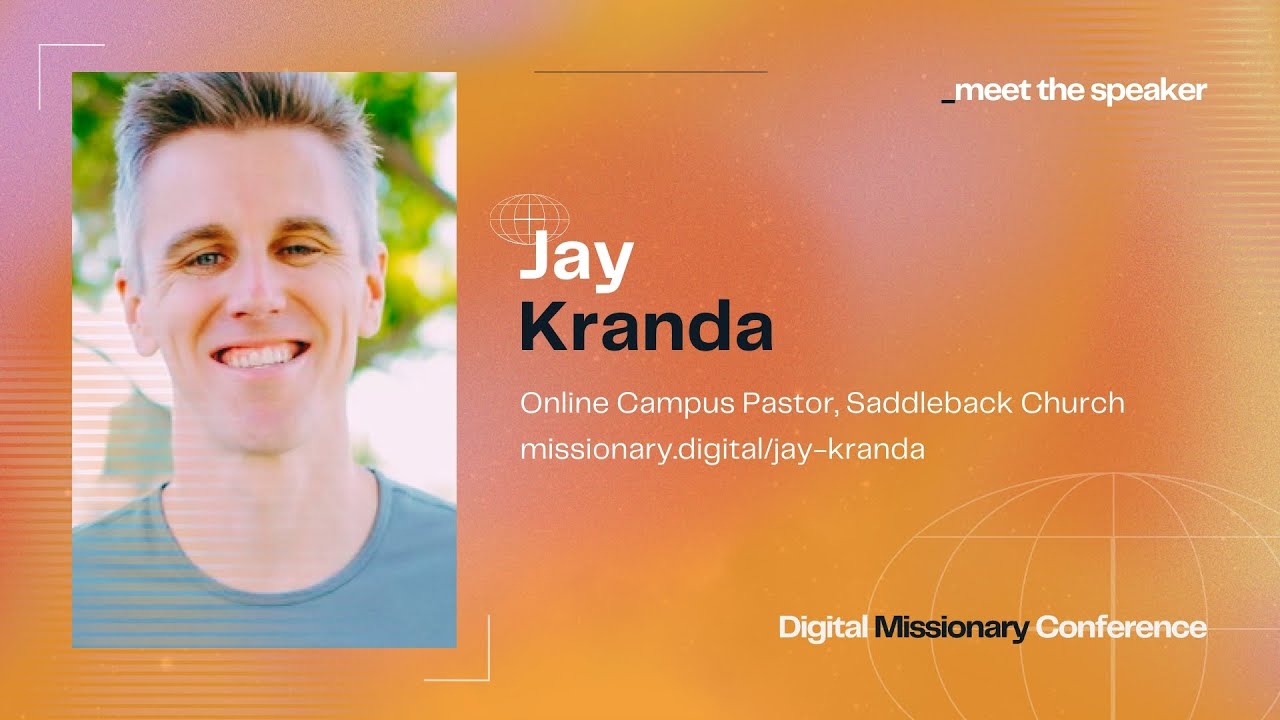
Jay Kranda
Well, thank you so much for having me. I'm so excited to jump into this. I love hearing how God is stretching and growing, even the platforms we're streaming this on, but I just wanna say kudos and thank you for doing what you do and thank you for leading the way you lead and even being interested in topics like this, like digital ministry and reaching people all around the world i wanted to just share a little bit right now about really reaching people globally uh with maybe technology you're unaware of and i bring this up as jeff was kind of alluding to there are all sorts of things god is doing around the world and sometimes what happens is we're only aware of the platforms and the technologies that we use daily. And so I want to just kind of maybe broaden the scope. Some of you might go, Jay, I already know about this. That's great. What I do know is that a lot of people aren't aware of some of the the opportunities that are either available to us now or will be continue to grow and kind of be more available in the coming months and decades. And so one of the problems with digital ministry is that it requires focus. There's so many different opportunities when we think about reaching people using technology, discipling people with technology. You're going to hear tons of ideas. It's kind of like a It's kind of like political opinions on the internet. Like they're infinite. Everybody has an opinion, a take. And with digital and technology opportunities, there's so many opportunities. It's like a multiverse of opportunities. And it can paralyze us sometimes. It can paralyze us. Should we be on this platform or that platform? Should we sign up for that? Should we pay for that? Should we go to this thing? and one of the things that's really important is for us to be focused think about the things that god has put on our hearts and one of the things is there are different platforms and things that make sense for different regions and places in the world and so the key is is that as you are listening today and watching and engaging is that you filter it through the lens of the community that God has put on your heart. And so the platforms you invest in might be different than mine, but you're doing it not to copy. You're doing it to get something done that makes sense for your region. the person that God's put on your heart to reach. One of the things that's hard is that there's always something new. I know right now we're streaming this in some VR experiences. And you know, you remember this not too long ago, the Apple Vision Pro launched and people go, oh, look, look at this thing. And they start going towards this. And if you've used this, you know, it's an amazing device. But sometimes we can get distracted, right? We can kind of go, oh, we need to do this. And the answer isn't that we need to do this. The answer is, should we do this? And this is the hard thing. This is the hard thing with technology and platforms and opportunities is that there's always something new. And in that moment, it can feel like the answer for us. And I think you and I as leaders, as people who want to expand God's kingdom, we got to figure out, does this make sense? Now, like my church, for example, like we do ministry in VR chat. We believe in VR. But one of the reasons why we do is because we have a leader in our church that builds VR spaces. And he's decided to be a leader of this. And so it makes sense for us. But it's really easy to go, oh, we need to do it because Saddleback Church is doing it. Well, no, you need to do it if you have a calling for it and if you have the right opportunities. So what I want to talk a little bit is what are some of the opportunities that are happening around the world that maybe you don't know about? And so the key here is as we decide what to invest in. And that's really my prayer. My prayer is that you leave this conference today and you leave encouraged and inspired to go. This is what we need to do. And I know you're going to hear a lot of ideas, but I pray. I pray that God nudges you in a direction that is clear. That's maybe the digital fog, the technology fog of what the next couple of weeks, months, and years look like, that just some of the fog leaves and you kind of get a little bit of a scope. And so the key is, what is your outcome? What are you called to do and where are you called to go? And remember, and I think all of us understand this, that the goal is not to fill a room, but to produce fruit. So what I mean by that is that, you know, sometimes we do things because we're taught it. And so we were taught in a room and therefore we replicate that. But we know the gospel isn't just about getting a bunch of people in a room, but it's about producing spiritual fruit, fruit in their marriages, their relationships, their families and their workplaces. It's not just about getting a holy huddle together. And this is where technology and digital opportunities are really infinite. we're able to leverage some of these things in countless ways. And I want to tell some of those stories that I've experienced. And so one of the visuals that I want to kind of plant in your mind, and maybe a few other speakers have kind of alluded to this, but I like to think about digital and technology in in the example of how you use digital in a relationship and so i'm gonna i'm gonna talk about it from the context of marriage you know i've been married over 15 years i have three kids with my wife jody she's my best friend and digital is something i use in our relationship to connect us and it strengthens our relationship, but I'm also very aware that digital can get in the way of our relationship. So for example, I don't text my wife throughout the day when we're apart and fear that I'm not gonna come home to her. I'm still coming home to her. regardless i still think that like you know a fancy way i might say it like a nerdy like star trek ways like we still have a spatial relationship you know what i mean we still come home and live under the same house but we're not fearful of using technology when we're apart i can send her a gift or something and and we can still feel connected and so i think that balance is really important so i say that as you think about these opportunities these digital these technology opportunities don't get fearful that it's going to replace physical see it as a strengthening opportunity while also having you know good awareness of where it could be a negative and so figuring out those lines and those lines are going to look different depending on who you're reaching where you're ministry. So I say that just as an illustration to really encourage you to think about some of the things you're hearing today. So obviously, we believe hybrid church is the present and the future. It's the reality and also the future that we're going into. But what does that look like? So a couple of things I want to kind of allude to, and Jeff was talking about this. We've been able to partner in some ways that are really cool. And I've been able to do a lot of ministry throughout the Middle East and throughout Asia and some parts of Eastern Europe. And I've seen this happen. One of the things that... especially if I talk to our brothers and sisters in Christ that are doing ministry, let's say in America and let's say West Europe, there's a lot of freedom of worship. And a lot of our faith, even in the last couple hundred years, have been defined by buildings and freedom. And so we think a lot around, oh, there's a church down the street type of thinking. And the irony is, is that there's a lot of places in the world that that's not an automatic thought. And a lot of us are kind of in our own Christian bubbles. And that's an amazing blessing that we get to ride that wave of freedom. But that doesn't exist in other parts of the world. And it's interesting because sometimes when I talk to people, especially here where I'm at in America, they just assume. uh some of these things and i i like to kind of nudge them towards there are places in the world where that freedom does not exist and you might be you know here in america we might fight against some areas of digital like expression because we go church is this it's got to be in a building and i would go yeah i mean church is that and something else and some of these places where i've been able to talk to pastors and work with ministries digital missionaries like there's amazing things happening a couple platforms i just want to highlight These are platforms that God is using in big ways and ministries are using, churches are using to do amazing things. And you probably have heard of them, but some of them you're not, you're probably not realizing how popular these things and some of the opportunities. One of them is Telegram. Telegram is this huge social kind of group platform where you can have a large group of people. It's semi-secure. There's some arguments around its security, but I've worked with, and I'll highlight one ministry. I won't get into too many details, but what they do is that they run ads to target specifically Persians. And what they do is they run ads to have faith conversations and they drive them to these telegram groups. And what they do is that they have two types of groups. They have a introductory type of group and they're trying to reach Persians that are either in Iran or in the surrounding countries like Turkey or Afghanistan. And what they do is they run ads, they drive them to these telegram groups, and then they have kind of a vetting process. And if you kind of go through the vetting process, they move you to a secondary group. And the secondary group, what they do is they do text-based small group Bible study. It's amazing where they'll have hundreds of people. And the reason why this Telegram group works, the strategy works, is first you have to understand is bandwidth in a lot of regions in the world is not limitless like we may have. They don't have hundreds of, you know, the type of speeds that I get in my home. That's not available in some of these places. And so they can't do video calls the same way as you and I can do. They can't do, they can't upload. I mean, they might have a very dated experience, but what they can do is text-based. And so what happens is they meet in these groups in a synced way over a period of six to eight weeks and they go through a Bible study and they answer questions in these telegram groups and God is doing amazing things through this. And I've seen people come to know Jesus and get encouraged to uh find maybe a next step type of group activity but telegram is this huge platform that's being used in very restricted areas and i think text based groups are this this experience that many of us maybe if you're you know 35 plus you may think no just get in a room or turn on video and you're not realizing how much of the coming generations are going to use this text base now now i see it a lot with my younger kids i see it how discord and text messaging is this default language for for so many people. But I think a lot of us who have church buildings and can physically gather and love Zoom video, we don't realize how much of this text-based strategy is going to be kind of more of a default way that discipleship is going to happen. And I see it in restricted countries and I've seen the life change. And I think Telegram is a platform we need to pay attention to. A secondary strategy is a group platform is Signal. Now, recently signal has been in the news because of some you know maybe some private conversations that have happened on this platform but signal's been around for a long time it's very secure and um there's a lot of people i know a lot of people in these regions they will only communicate on signal because it's one of the few platforms that you can have full encryption or at least encryption to the point where you your trust you you can trust it and people don't realize this that there are places in the world where if you get found out that you know jesus and if that traffic flows through maybe a government server there's risk and so the the argument here is people don't realize that there are places where you know that the argument here is that there is freedom of worship but not freedom of conversion And so there are places where the government will just say like, and I'll take an example. There's regions like in Pakistan that you can freely worship as a follower of Jesus, but you can't freely convert. And so evangelism is highly restricted. And so this is why platforms like this, where if you think about this, if you're trying to do ministry in a region where there's high restriction, how can you have candid conversations with people, Facebook and Instagram, and even WhatsApp are platforms where people are afraid. to maybe change faiths or even have questions it's kind of these countries what they do is they try to restrict questioning things and and so this is what that means is that their encryption is going to become more and more important this is why things like cryptography are going to be are important and so i say this that understand that having faith conversations to some of these platforms can be really scary especially if you've grown up in a a faith that's that is separate and and how can you ask a challenging idea and this is why signal is a platform that has really rise in some of these regions because they're very powerful and a lot of the same principles as telegram exists where you have synchronized you have you know um small group strategies that are text-based now signal has has less scale. Telegram, you can be a lot bigger, but this is why Telegram is less secure than Signal. Signal's super secure. The last platform I wanna highlight, and many of us have, I've seen a huge adoption of this platform in the last, I would probably say 18 months in the US, but WhatsApp has been around for a long time. obviously it was acquired by facebook or meta a couple years ago but whatsapp internationally has been this huge platform many of you are like jay of course whatsapp is is a big platform why are you even talking about this well there's a lot of us people that still don't understand this and i would say that whatsapp is is a growing platform one of the things people don't realize and i'll just shout this out that you can run run ads on the meta platform to whatsapp And I think this is an underutilized thing where you can actually, instead of having starting ads on Facebook or Instagram or YouTube, you can actually do it through WhatsApp and you can target people's WhatsApp. And what's important about that is WhatsApp, even though it's not as secure, let's say as a signal or even like iMessenger, it is a phone number. People use it as a phone number out in most places in the world. And so it's an opportunity to start private text messages with people. And I think it's an underutilized strategy. And I've seen some really cool ad strategies around the world around this. And so, and then I would just fill in what is the... what is the other platform you might go jay you're forgetting this and this is the fun thing about thinking about reaching people discipling people using digital tools there's always another platform there's always something you're not aware of and i want to encourage you to think about that and i want to encourage you to encourage other leaders to think about the platform maybe you're thinking about and they're not because trust me there's always something else that god is doing and so the last thing i'll say is that one of the things that i would just encourage you as we think about evangelism and discipleship is that there's always something new and one of the default thinkings or like traps we get into is that we think oh that's not relevant because i don't use it and my encouragement and i think you and i know this but one of the encouragement is that just because i don't use it or i'm not aware of it doesn't mean it's not relevant There are so many popular bands, technologies, people that I don't even know who they are. And they're famous and they're useful. And just because I don't know about it doesn't mean it can't be used. And so next time you hear about a new platform or a new technology, maybe it's on this call and you go, ah, maybe your eyes roll. Just take a second thought and go, can I use this for my objective, for my ministry, for my org? And if the answer is yes, maybe you should explore it. I love this. This is a famous kind of illustration from the blog, Wait, But Why? And I won't fully unpack it, but they kind of go through this idea of some of the innovations that Elon Musk has gone through. And I know Elon Musk is kind of this very political figure now, but he's done some really cool technical things. and one of the things is there's this conventional wisdom kind of reality box and if you think about your world and like this like the way we think and you think about things that were possible the last 10 to 15 years ago and you think about the way elon was able to challenge you know the car industry the space industry and you know so on and so on and he thinks about it not like oh this is how everybody thinks he thinks about what's possible and i bring this up because one of the things is as we enter into new thinking around digital and new thinking around evangelism new thinking around discipleship it's easy to go well this is just how it's done and i want to challenge us to think about what is possible considering the resources now and the kind of the visual on the right there there's this visual of reality and the one of the problems is a lot of people their framing of reality is based off of the places they've been the things they've read the things they use. And sometimes our box is limited based off of how many inputs we get in. And one of the things is Elon early on was able to grow his box. He was able to think beyond. And a lot of people told him, you can't launch a space company. You can't launch a car company. There's no way. And he was able to expand. Now, I know you and I aren't Elon. I'm not trying to make that argument. But I'm trying to say is next time your box goes, well, you can't use Signal. You can't use Telegram. Just go, is that conventional thinking? Or is there some possibility there? And my encouragement is in my prayers today, as you're hearing all these cool ideas, that you kind of grow your box in a bigger way. So in closing, so the question is, is what are you trying to do as an org? And I would encourage you to focus on opportunities that make sense for your church. And maybe, maybe there's another possibility. There's something else that God is doing around the world that you can borrow and learn from. And I want to encourage you to continue to be open to what God is doing and try out some new things in the coming weeks, months, and years. ultimately not just to be relevant and cool but to reach more people and disciple people so thank you so much for letting me sharing jeff and team i do want to highlight my book online church is not the answer if you want to hear more some of these ideas i have a book that i released not too long ago you can check out but yeah so i know we'll move into some q a here jeff but uh but i hope that encourages people that have been engaging in this conference so far
JR
Jeff Reed
I tell you what, Jay Krantz is plugging his book, Online Church is Not the Answer. A great book. It was a great read. Actually, it was really, with some of our leadership, it was really eye-opening. Not in the radical concepts of it, but how it was packaged and presented in a framework to help physical churches better understand the potential of digital. And so love it, recommend it for physical churches where we are. And Jay, such a good conversation. I love this. We spent some time earlier talking about new wineskins for new wine, but that doesn't invalidate the old wineskins, old wineskins. People drinking old wine want the old wineskins. And so thinking different doesn't necessarily challenge It's not against another model. It's doing something different to reach someone different. And so that ideology, man, is just spot on with where we're going. Now, we've got some people on here. By the way, if you've got questions, throw them in chat. I'll try to keep up. Chat is flying so fast on the screen. I feel like I'm on Twitch. Like, I can barely keep up with it. but um the uh but one of the things that that we're seeing by the way we've launched you know we were in discord uh when it was us-based and then we started to move globally and uh you know our global leaders said hey if the church digital needs to go global we need to be on whatsapp And so we launched into WhatsApp. It's whatsapp.thechurch.digital to join that community. We just have passed 200 people this morning, digital missionaries doing that whatsapp.thechurch.digital. And so like a powerful community towards it. And there was a huge learning curve for us. To be honest, I don't even think I had an account. Like I would never use WhatsApp. And now like it's my number one app. Like I have four. forced myself to kind of adapt into this whatsapp mindset because now i'm engaging with uh with this huge audience base how do we like you presented two or three different apps we were looking at it and like we literally we had signal the same thing you put on that slide signal we had whatsapp we had telegram and you presented strengths and weaknesses for that you know early on it was kind of a i don't want to say crap shoot but it was like what are we like which one do we do which one do we pick where do we go what what are some things that that we should be looking for as we're heading into that yeah i mean i think and again it kind of alludes to that there's there's so many platforms so many opportunities and it can paralyze you because there's always something else and so i think it's important to understand there's a difference between um
JK
Jay Kranda
there's a difference between the things you use and the things that people who you're trying to reach use. And so the question is not, do I like the platform? The question is the people who I'm trying to reach, what do they use? And so I think that the key is, does the platform get the task done? And is there a enough activity on that platform where, the people you're trying to reach actually engage. And so one of the things I do, and I will just say that I will launch a lot of things privately and slowly roll out and just see if there's a good adoption of it. And if they don't use it, then I kill it. And so like, for example, like I, I was just, I was doing something with some, with some ministry leaders and I rolled out a signal group actually. And I really wanted it to be on WhatsApp. And, but I heard from some people that signal was better. I rolled it out based off of the recommendation. And one of the things I noticed is that people weren't using it. And so I actually, I killed it. And so one of my encouragement is, is to test often and frequent around this. And so, um, but again, because like I've done that too, where like a couple of years ago, I remember we launched a WhatsApp and I was kind of reluctant to, cause I didn't want another platform. But I found very quickly, because people were there, what happens is, I was reluctant, I launched it. And then I noticed people kept using the WhatsApp group, and it fed it. And what happened was, you know, there's always this doubt. You know, anytime you have like a new platform, a new job, a new leader, there's like doubt, because you're like, is this actually going to be useful? And what I saw is the activity reinforced me to invest more. And so if there's non activity, let's say after a couple of weeks, months or whatever, then, you know, to kill it. But I think it just comes down to, do people use it? And so don't be afraid of launching something. And if it doesn't work, kill it and launch something else. And, and I've, I've done that so many times now that I'm not afraid of launching it and not working. And, and then, but I've had like the 15% that really worked and I'm glad I launched it.
JR
Jeff Reed
Yeah, it's interesting you say 15% actually works. And you know, we're in the middle of is it actually working? It's funny, my computer is crashing at this moment. And so my mouse is dead. I just lost alter live on the screen. But I think I saw josh hill uh post something uh in chat that i wanted to highlight talking about really what what the difference is in what we're talking about and this is really focused for us jay because we we're looking at the relational aspects of digital not using digital as a communications tool but as a community tool and recognizing that it's more about engaging in community Even, you know, I know you're in VR, you were formerly an altar in the virtual spaces using, you know, WhatsApp or Spatial or Telegram to create a community vibe. You know, that's so important with what we talk about at the Church Digital. Can you talk a little bit about how you're doing or seeing that at a global level, domestic U.S., what digital community looks like compared to communication?
JK
Jay Kranda
Yeah, I mean, I kind of unpack this as kind of, there are different types of expressions of community or at least digital kind of interactions. I talk about it as like the four S's, where you have like streaming platforms, which are kind of like large gatherings. And I think there's a lot of digital stuff that happens online that's very large and great, like streaming here on YouTube. AltSpace, Altar Live, all these things are great large platforms. And I think that's great. And I think a lot of ministries and churches embrace the large platforms pretty easily. I think we're good at hosting events. I think that's something that we're just natural at. I think we struggle more at the, I call it strengthening type of things or smaller gatherings. And so this is why you need the Sunday morning, but you also need the home. And both of those together is church. Sunday morning only is not church. It's much more. And so this is why, like, I think you need the third, fourth place type of experiences. And so this is why, you know, Alter Live, you know, for example, like they have like the small group type of things. You know, Zoom has breakout rooms. You have WhatsApp groups. You need spaces where people can run into each other. And this is where, you know, a psychologist would call this social proof. When I come on a Sunday, I walk into a room, let's say here in the U S and I see, Hey, I'm not the only one that believes this. There's something that happens there. And I think this is why, like, this is why if you just, and you and I believe this deeply, where if you just stream on YouTube or whatever, and you call that online church, that's not, that's not online church. That's just an event. You need to have groups. You need to have a WhatsApp group or spaces where people can interact with each other. You know, I used to call. I used to call this like, you know, here in Southern California, we have a patio because, you know, we can meet outside all times of the year. You know, Florida, the same thing with you for the most part. I know everybody in the middle of country has snow right now. You're like, I don't even know what that is. But for us, I needed to have a digital patio. And so one of my, this is why my number one thing that I kind of echo, and if you read my book, if you read my blog or anything, I say this over the time, we need to think less about getting more views and getting more people on video. Like, you just need to get more, like, this is why, like, I encourage, like, if you just host a monthly or a weekly or bi-monthly, whatever it is, Zoom, where you just hang out with people and you stack that month over month, you start to actually build a real community. And I think a lot of churches and ministries, they have the Facebook stream because of COVID. They stream on YouTube. They do Chop or Alt Live, whatever it is. And I think I go, if you launched a WhatsApp group for your online community and- some zoom discipleship classes and you stack those then that's church and and guess what that's what church is anyways the church didn't just gather at the temple they met house to house and they they interacted they had meals together and i think digital is really good at those things this is what why discord has excelled in all these different things but i think churches struggle with well there's only like three people that meet well don't you got so distracted by the hundreds views on youtube that you don't value the three people and i would encourage you to value the three people stack that and if you do that long enough there's community that develops and and i was just spoiled that i was able to be an online pastor for 10 years and i did that and i was able to stack it and and we i think we bore fruit because of that deep discipleship type of stuff
JR
Jeff Reed
Jay Crandall, ladies and gentlemen, my heart goes out because we resonate so much on this. Don't be afraid of the three people. We talk a lot about connection and community. The church service is, at the weekend, is a connection event. But if all you're doing is connecting, and if you don't have community, evangelism, discipleship, building trust, establishing relationships, all that happens at the community level. And so, and that can happen in Discord, in WhatsApp, in Signal and Telegram and all that. You can use those digital tools to create that community. And yes, hybrid can complement that if you're aiming towards hybrid. But if you're in a position where you don't have that opportunity, you can still create that community in digital using these digital tools. And so, Jay. Man, I've loved the time. We really need to hang out. I haven't talked to you since the new innovation title. And so I want to get you on a stream at some point and dive into that. But that's going to have to be another day, man. And so we're going to pivot. Jay Cranda, Saddleback Church Innovation Pastor. Jay, thanks for being on with us. And we got to move on to the next thing. Thank you, sir. Love you. Appreciate you.
Auto-generated from audio, lightly cleaned for reading. · Watch the full episode →
