⌕
MN
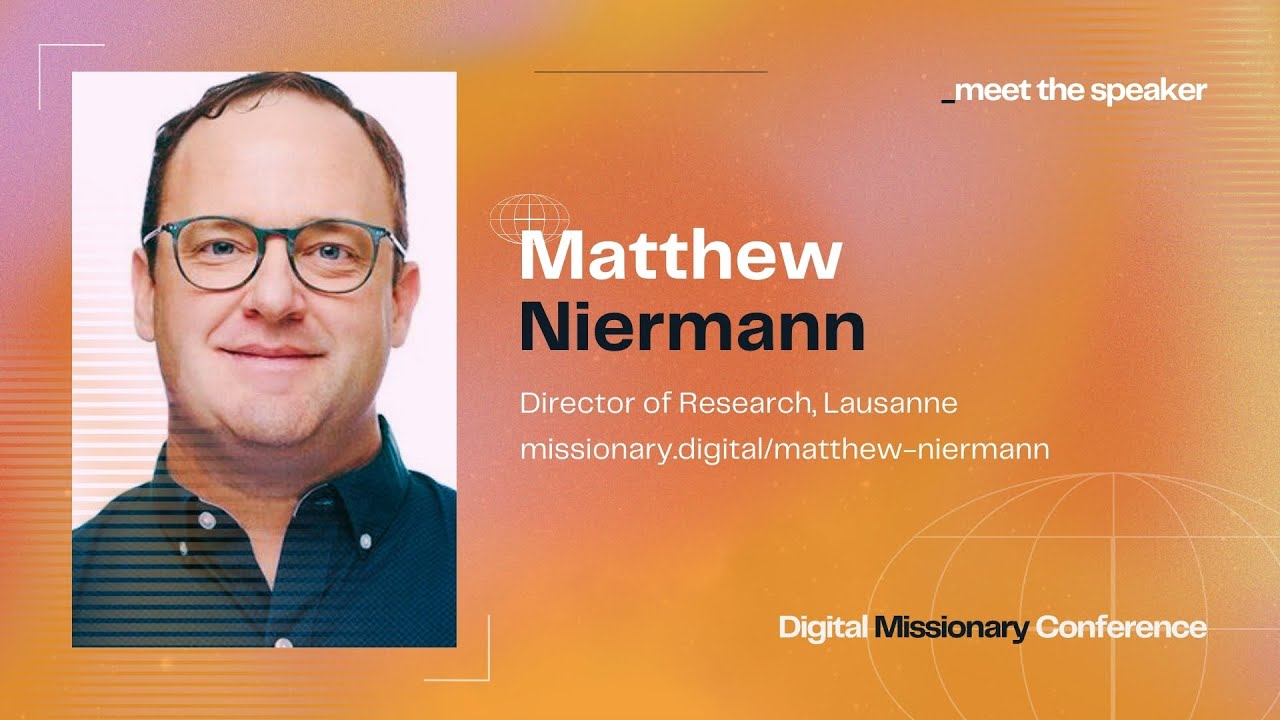
Matthew Niermann
Good morning, good afternoon, good evening to everybody out there. Jeff, it's an honor to join you here today, and thank you so much for partnering with us at the global scale in the effort to accelerate the Great Commission. As Jeff mentioned, we were in Korea together shortly in September last year, and we pulled together 5,000 global leaders from around the world, over 200 countries. And ladies and gentlemen, let me affirm what you are doing is incredibly important. One of the three major conclusions that we came out of that global Congress on accelerating the Great Commission is that digital needs to be a primary focus, a primary means of engagement, and a primary exploration. It's no longer fringe, Jeff. You guys, all of you out here, all of you digital missionaries, it's no longer fringe. You are now core. You are now within the Great Commission advancement. main center of things. So welcome, guys. You are no longer pioneers. Welcome to the middle. We need your leadership. We need your help. We need your development skills. We need all the speakers on this conference to help us through what that means and what that would look like as we continue to go forward. But thank you today, Jeff. Today, I'm going to begin providing maybe a little bit something different for you guys. There are many really great speakers here talking about the role of tech, what tech to use, Signal, Discord, all of that. That's great. That's wonderful. But today I want to talk a little bit more about who we're reaching and maybe not less about how we're going to reach them with specific tech. Because ladies and gentlemen, we have to know the world so that God can be known by the world. Even though we're using WhatsApp or Discord or Signal or whatever we're using, we still have to understand who we are reaching and how to contextualize that message to them. And ladies and gentlemen, let me tell you that the world is rapidly changing around us, and we have to be aware of this. So to begin, let me start here in our time today and talk a little bit about where we are currently in the state of Christianity. Now, the fun part of this presentation is we're going to show you a lot of graphs, a lot of charts, going to show you kind of graphically where we are. If a chart flies by and you didn't see it and want to study it more, we'll give you a link at the end to the report. It's all free. It's all digital. You can examine them a little bit more closely. But to begin, this is where we are currently in the status of global Christianity. You can see the map here. The darker the blue, the higher percentage of Christianity is in there. So if you just kind of blur your eyes, you can begin to see that Europe, North America, Latin America, South Africa, Australia is more blue, right? That middle chunk in there, some of Asia and Northern Africa is not blue. But you can also begin to see the United States has the highest percentage of Christianity per country, but it's no longer what we might think of as like Europe, but it's Brazil and Mexico and China and the Philippines. The state of Christianity, this map doesn't quite do it fully justice because it's a very dynamic thing that's happening. So this chart begins to say, hey, from 1900 to 2050, We've had a radical shift in the way Christianity looks across the world. In 1900, it was primarily Europe and North America, with a little bit of Asia and Latin America in there. We zoom all the way forward to 2020, we can begin to say, well, that's almost completely inverted. Now it is Africa, Asia, and Latin America, and continuing as we move to 2050. So an easy way to remember this, guys, is we begin to think maybe in the 1900, the prototypical Christian would have been, let's say, a British white male. But the prototypical Christian now, if you will, if we had to kind of choose a symbol, it would probably be a Nigerian female. And this is partly due to this rise of missionary activity that happened from 1900. You can begin to see the rise of missionary activity all the way across the spike in North America. in Europe and Oceania. And now we can actually begin to see, starting in 1990s, 2000, an unfortunate change here. North America has remained flat as the highest mission sending agency region, but you can begin to see Europe and Oceania falling off. But here's a storyline we're gonna see quite often in this presentation. You can see that gold line and the green line, the blue line. Ladies and gentlemen, this is what we call the rise of Asia and the rise of Africa. Fundamentally, the amount of church and Christians within those regions have risen radically, and the missionary activity is beginning to kick up. But guys, there's more good news. We are doing wonderful activity as we begin to think about how is the Great Commission advancing. Look at the amount of Bible translation efforts going up. Just this exponential curve that's happening since 1920s on. And look at the church planting movements and disciple-making movements. Again, an exponential kind of curve. it can begin to see the fruits of that as the amount of evangelized or percentage evangelized across the world is moving up. So in the West, it's relatively high evangelization since 1910. But we begin to look 1910 now, we can begin to see that rise of Africa and rise of Asia. But ladies and gentlemen, I'm here to show you one more slide in this particular series. This is probably the most boring slide in the entire deck, but probably the most impactful slide. Here it is. This is the percentage of the world that consider themselves Christians from 1900 to 2050. Unfortunately, when you zoom all the way out, despite all of our efforts in Bible translation or church planting movements or missionary activity, we have been fundamentally flat. Now, I don't want to disparage anything that our forefathers did in the missionary activity. It was wonderful. The population has boomed and we have kept up with global population and global population growth. But fundamentally, we have not grown beyond that 33% to 35% globally. So let's begin to talk a little bit today about what are some of the challenges presenting some of this, and also what are some of the contexts that we have to deal with, and how do we begin to move the needle? How do we begin to move that up? And let me say, one of the fundamental ways to help move this up in our age is everybody here on this call. We absolutely need you and your digital engagement and your creativity and your pioneering to figure out new ways that we can move this needle up. So let's talk briefly. Here are some few challenges that we've seen surveying and exploring the world. Number one, we have this need for discipleship, right? I really appreciate the last commentary, Zephan. We just don't need a show. We need community. We need discipleship. know we asked this the only thing i want you to look at on this chart is that top right number one gold bar we asked 1500 leaders from around the world who are in leadership positions in evangelical saying what's the biggest need we have in great commission efforts today by far as you can see that floating uh gold square we have a need for discipleship is our internal evaluation and particularly if you begin to say hey are we discipling well in the great commission You can begin to see blue. We are saying, yes, we have adequate discipleship. But unfortunately, no discipleship actually outweighs adequate discipleship. And in a large chunk in the middle, just this limited. And the results of that is this. When you ask the churches, what percentage of your people are ready to share the gospel or capable to share the gospel? At most, 47% in Latin America, 46% in Asia, 40% in Africa. then down to north america and ocean like 37 one in three in the pews maybe can share the gospel there's this lack of discipleship that's there so yes we need shows yes we need to have connection yes we need to have that social uh that the social affirmation that other people believe the way we do but absolutely the three as we just talked about jeff those three people on the call the discipleship of the three is incredibly important and what's fundamentally missing Another big challenge we have here is what we call resource allotment. And this comes in two different flavors. This is a hard chart to watch a little bit here. So this is on the left is everything available, all the money available to Christians globally to our best estimate. That little blue slice there on the right is how much is given to Christian causes overall. And then if you look at the pie chart, that's that little sliver kind of expanded. Most of that goes to churches or parachurch activity. And that little gold sliver, which is a sliver of the sliver, goes to global missions. I think we all have a sense there's not a lot of money that is headed towards global missions. But I think the kicker or the heartbreak here... is if you look at that light blue pie square, it's about the same size as global missions. That's how much money is lost in ecclesiastical crime or corruption from the church or churches stealing from churches or people stealing from churches. We lose more in ecclesiastical crime than we do in global mission spending. This is a real challenge here. Another piece is just our manpower. This is a fun graph that we put together that says, hey, we have about roughly 450,000 missionaries in the world total. and then we can see the the two different populations there's about 4.57 billion people who have heard the gospel and about 3.34 billion people who have not heard the gospel now each of those little lines coming off of our missionary circle is about 5 000 missionaries so you can begin to see we're sending the vast proportion of our missionary force over to the people who have already heard and just very very few people to the other half of the world who haven't heard a whole lot The advancement of the gospel requires resources and stewardship of resources, both financially and human resources there. But here's the third challenge before we move into context. And this is why we are all here today. The third challenge is we are now living in a digital age. This is fundamentally a different world than we were 10, 15, 20 years ago. How do we engage in this world? How do people enact in this world is fundamentally different. we can see this in the numbers right so this is the rise of the internet if anybody had any question whether internet has grown i'll give you some data for it you can look at the left this is the number of people using the internet since 1990. the yellow line the big the big line going up is is the asian line with the highest amount of population generally speaking in the world or the percentage of people on the internet right you can begin to see that that rising too so let's take this look at this map form the deeper the color the more use of internet there is a percentage of people on the internet Again, we're broadly seeing this in North America, South America, Europe, Asia, with a little bit less in Central Africa. And that begins to also correlate to social media use around the world. On average, 58.4% of the world is on social media daily. That's huge. Half the world. There is no other statistic anywhere in any data set that says half the world is doing something. This is vastly unique. Half the world is on social media. Over half the world. You don't see that anywhere else. You can begin to see your particular region from where you come from, where this is. Again, those numbers kind of map correlated to internet usage. All the Americas, North America, Asia, with a little bit less there in Africa. Populations then begin to see where people are on the social media. The gold bars being Asia. Majority of social media users are in Asia. Eastern Asia, Southern Asia, Southeast Asia, and Western Asia. And that takes up over half of the world's population on that. also begin to see that the percentage of time on the internet is or on screen is huge right so uh let's see look so south africa is the highest nine hours a day japan is the lowest three hours a day and the world average is six and a half hours a day i i can i guarantee you that nobody sits in church for six and a half hours a day But these are places to reach them. And this is allowing us to begin to think differently. I'll just give you one slide here. How is it that we engage people digitally? Well, there's a wonderful movement happening in digital Bible engagement. This is the data provided to us from YouVersion. And also Faith Comes By Hearing on the right. We're doing a lot of really great testing and experimentation. The amount of digital Bible engagement is radically increasing, but also beginning to test some assumptions. Test and break and go. Test and break and go. we're actually finding that multi-language apps are not performing as well as single language apps for Bible engagement. So Faith Comes By Hearing are launching tons and tons of these single language apps, getting a lot more traction than these multi-language apps. Again, we're learning, we're testing, we're growing within that. But here, ladies and gentlemen, let me spend some time now here on what I would consider shifting context in the world. If your goal is to accelerate the Great Commission, and your goal is to reach people, and your goal is to bring the gospel to the world, By whatever means technologically possible, you have to know the world. You have to know who you're reaching, and you have to know what the world is doing. So a couple points here for you to keep in mind. Context shifts are going to radically be shaping our world in the next 10, 15, 20 years. Like I said before, it's this rise of Asia and Africa. If you look at the population growth across the world, the gold colors are Asia, the light blue is Africa. Currently, Asia is the highest population, but they're about to peak by all projections. So Eastern Asia is going to start moving down and Central and Southern Asia is coming up. But look at that rise of Africa. Boom, all the way up that light blue is going to be the highest percentage by 2050 and 2010. It's going to cross that marker. You also begin to see this is really driven by a youth population. so the the darker color is the percentage or the number of people under 15 years and the the lighter is on the right side of each bar is over 65 years old look at africa guys 40 of its population is under 15 years old look at asia 25 of its population is under 18 years old 15 years old same thing with latin america if we're talking about technological engagement youth generally speaking engage with technology more and the vast majority of the growing population in between now and 2100 is youth there's a a distinct time here for the next 10 years where we can engage with youth through technology and radically shape the entirety of our world if we can shape african asian and latin american minds through digital engagement the entire world will change by 2050 and 2100 think about who we're reaching who the strategic populations are Another one here is the rise of the middle class. So a couple of things have happened in the world over the last 10, 15, 20 years. First, that has created this massive movement. First off is we've had this growth of urban populations. At this point, over half for a couple of years, 10, 15 years now, over half the world lives in urban populations. You can see that gold line and that teal line again, that's a rise of Asia, rise of Africa and the percentage of urban populations. So people have moved to the cities. There's also been a great effort to reduce poverty around the world. So this is one of the most radical things humans have done. And since 1990 to 2020, with a concerted global effort, it has halved. the amount of people living in extreme poverty, from 2 billion to 1 billion people. And we haven't seen anything like that in the history of the world. This concerted effort to reduce poverty has been absolutely amazing. You can see that it's really primarily been in Asia, and not as much in Sub-Saharan Africa that remains, but the Asian population has come down. So if you put these two together, and what that does for us now, we can see, is this rise of a new middle class. In the next 10 years, two point at least 2.1 billion people are going to be entering the middle class a fifth of the world is moving from poverty to middle class and primarily a lot of this is in asia you can begin to see india china the rest of asia is primarily where the distribution of new middle class would be uh with the rest being there but ladies and gentlemen this is really important because this is this is a fifth of the population of the world who are now engaging at a different kind of level with technology has access to technology in a different way, has more leisure time than the impoverished, and maybe more specifically, as you're beginning to reach them, think about them, they're asking different questions. The questions you ask when you're in poverty are completely the pressures or questions or wonderings you have when you're in the middle class. So as this huge population comes, this is an absolutely fantastic population for the digital missionaries to engage with a new group of new technology, new leisure time, asking new questions, looking for the gospel. This is the people that we need to be thinking about at the global scale with our digital missionary work. There's one more population here as, as our, as our poverty has declined, our cities have come up. We've had more services available. We are just living longer. So if you look here, this is the global population between now and 2100. You can see that there's one that gold line at the bottom spiking up. That's 65 years and older. The aging population is just going to increase globally. You can see from the left 1950 to 2020, even the darker the color, the older they are. Particularly in North America and Asia, we are just living longer, living extended amount of time. So you can see this huge population sampling a few countries here of people who have this massive aging population. Now, when we begin to think about digital missionary efforts, This is an absolutely unique population to be thinking about. It may not be obvious that like, hey, old people don't do tech well, but let me tell you this. Old people are becoming more and more isolated, generally speaking. They don't have the ability to go to church as often. They don't have the ability to engage with friends as often. So we're seeing this rise of engagement of technology within the elderly population. Now, if you can imagine, maybe they're not interested in the big show, but can you imagine a Zoom group or the gathering three to five elderly folks how important that would be in their life to have regular connection with people that they don't see the rest of their time you know i i went to seminary and some of the the one of the classes on pastoral ministry i remember is one of the most important things you can do as a pastor is hug the elderly For most times, they just don't have the ability to have interaction. So if we can reach out to the elderly, we can begin to provide not only care and witness, but discipleship. This is an amazingly influential population to the rest of their family, but also a needing population that we can serve and support well. A couple of things here and then we'll wrap it up. We also have a major context shift in the fact that there's declining trust around the world. So you can see that the amount of people who say that most people can be trusted is shrinking and shrinking, shrinking, the darker, the less they're, uh, most 77% of the people think that there's more conflict now and they can't share values. Uh, but there's also this, this notion, this is one of the most radical stats I discovered through all of this and surveying the world. 83% of the world say that it's up to everybody to work out their own set of principles and decisions. There is no external reality. There is no external truth. Broadly speaking, 80% of the world across all age groups say, well, it's just about me. So we have this trust issue, right? Where people begin to distrust mainly institutions and distrust other things. Now it varies around the world. Asia tends to have more trust than other parts of the world. But this is particularly true in youth. This is a nice graph to kind of show broadly with speaking. So the youth do not trust religious institutions, broadly speaking. They do not trust news and media. They do not trust large corporations. They do not trust national governments, broadly speaking. So this is a unique niche that I believe digital missionaries can play in that they can be almost like an international organization, which is one of the highest trust levels, or academic kind of mentorship is the highest trust level. Because it's not church as in a building, I think there's like an ability to say, hey, we are church, but we're not church, like we're something new, and people don't know whether to trust it or not. It's kind of a blank slate. So it's up to us to be able to build that trust and say, yes, we're the church, we said internally, but it doesn't feel like church, so we've got the ability to kind of gain trust as we begin to go. But lastly here, ultimately all of this comes down to what I would say is the largest question of our age. People are asking this and we have to be able to provide an answer to it. It's a question of what does it mean to be human? Now this question of what does it mean to be human is being interrogated from a lot of different angles. It's being interrogated from gender and sexuality as more and more acceptance of homosexuality or even considering what our gender roles, you know, the conversation is active around the world. to the rise of artificial intelligence and biotech. We can begin to see the development of biotech rapidly increasing in artificial intelligence. AI can now carry out at a human performance level nearly all tasks. And it's on our mind. This is all the kind of web traffic as we thought from 2018 on in the English world from like, hey, how much are we thinking about Jesus in the world? How much are we thinking about Christianity? And how much are we thinking about AI? You can see that spike in the green there. This is interesting, guys, as we begin to think about sharing the gospel online. As we think about the gospel, there's a primary anchor point, if you will, to the gospel. God created the world and it was beautiful. Man sinned and needs redemption and restoration. God sent his son, Christ, to bridge that relationship and help provide that reconciliation so that the world can be restored and there can be eternal life with it. I think we're about to face one of the largest ideological challenges to that basic gospel message we've had in a long time. This is akin to a bit when evolution came around. Evolution began to say, well, I'm actually going to challenge one of those four premises, God created the world. And if we challenge that premise, now a lot of people begin getting knocked off this notion of the gospel can be valid. And we still see that to this day. But can you imagine if we can begin to say, Hey, you don't need a God for redemption or restoration. You can do that biologically. You can do that virtually. You can do that physically or through gene editing. You can just erase the redemptive needs there. You can escape or erase or change. Or do I need eternal life through Christ? Well, we're not there yet, but perhaps there's a technological hope that can provide us. uh that eternal hope so not only are we fighting or beginning to have to adjust or attend to if you will the fact that god created the world is a question now we have to attend to the question of why need redemption and god is the only way to eternal life so this message as we attend to the world is really anchoring in this bigger question what does it mean to be human and a huge question for our day but ultimately ladies and gentlemen we have to do this in community to kind of emphasize from the last talk here. If you look at everything we've written in the English language from 1940 to now, like kind of a radical shift has happened. And actually break this all the way back to 1860, it's the exact same. Up until 2000, early 2000s, we wrote far more about the community than the self. But we had this shift to the self in 2000, 2007, where for the first time in the history of the world, from my research, we now talk, think, write more about the self than community. So this is a radical shift that we can do, even though we're individualized, perhaps in our digital missionary work and our tech, we are doing this in community and calling people to community to answer these massive questions, to reach these new populations, to understand what the world is, where the world's going, so the gospel can be heard by the world. Ladies and gentlemen, a heck of a lot more out there for you to begin to look at. If you want, the State of the Great Commission report is here, lausanne.org slash report. As Jeff said, it's about 500 pages, 150 different authors from around the world, 100 pages of original full graphics. And for our international audience here, we have this in French, Portuguese, Spanish, Russian, Mandarin, and Korean, fully translated, all PDF-free for you to use. All right, Jeff, I think I'm up with my time here, so I'd love to chat with you.
JR
Jeff Reed
Awesome. Hey, thank you, David, very much for doing that. Excuse me, Matthew, thank you very much for doing that. A wrong name popped up on my screen right then. Hey, no, thank you very much for sharing, Matthew, on this. I got to tell you several things pop up. One, you are so much smarter than me. And so thank you for sharing some of those stats, but in an easy way for us to process. At the end, at the global level it's fascinating to me how i see uh digital engaging you know it's interesting i saw jesse carbo friend of mine pop in the chat you know that he was in havana cuba and um you know doing some mission work and saw a young person engaging on an iphone And I can echo that. We're actually using WhatsApp to start to do some pastor training in Cuba in some of the closed areas. Maybe I shouldn't have said that, but oh well. And then we're also doing, you know, I've seen globally in Africa, like literally there are people that will borrow someone else's iPhone for data to be able to keep up with us and watch our YouTube videos or jump into a cohort. And so like we're seeing, This happened at a global level. I hear you talking about building trust and the necessity for that. And we don't utilize, people don't trust organizations. We're seeing that organizational trust, institutional lack of trust, I should say, at the global level, especially as the metaverse and blocking crypto start to influence as well. And so there is an institutional lack of trust. we're redefining what church is and in the chaos i hear you saying well you know this digital community could be a church and it's the ability to trust maybe a new institution a new wine skin a new approach towards that that's really interesting to me like i've had conversations and i've read talking about another guy who's way smarter than me the former u.s surgeon general actually you you probably read this the insta uh uh i still was at the uh uh loneliness the the strategy oh my gosh i'm blanking on the term but he did a massive report on the lack of loneliness in um the lack of the issue of loneliness in digital and virtual in in the the younger people i'm sorry my internet's breaking up on me i'm losing my thought the u.s surgeon general under biden posted a a report massive several hundred page report talking about the issue of loneliness in gen a and gen z and said it was a major catastrophe what he actually said was not that we should run away from technology Three of his top seven pillars were utilizing technology better. And one of his seven issues that we should change is embracing digital community. The question I would love to ask you with everything that I just said is, do you have stories or examples of how community is being used at a global level to build trust to establish relationships like i know we're seeing at the 40 000 foot level of some of that's happening do you have an antidote or something that maybe you can share of how that's working
MN
Matthew Niermann
yeah i think i think i have a lot uh jeff but maybe i'll characterize it as like here is a version of this that i've seen quite a bit imagine this guys imagine a world where i am youthful in asia i am lonely i am now detached from my upbringing real roots and culture and i'm in a new middle class right and i'm trying to figure this world out with this uh and then I don't trust the religious institutions, but now I find, find somebody in line and I'm curious about this and I've got curiosities. And first thing I do when I'm curious is Google it. Right. Or, you know, there's other international versions of that, but I Google that. And then I come on, let's say they say, or this institution, this kind of church missionary, a digital missionary there. I mean, I've got dozens of stories at least, um, where that setting is where we're, we're engaging and that digital missionary can say, Hey, This is not a one-off, Jeff. This kind of characterization of a youth in Africa and Asia in a new middle class, in an urban setting, detached from its culture, asking new questions, lonely, and using the internet to figure out answers. And who's there? One of you guys here on this call. and that's hitting at the fundamentally low hard time and then they get pulled into a broader community what's asked being used a lot around the world for this kind of whatsapp community development and now i've got a community now i'm not lonely now my answer is to my to my questions about hope and future and all of that like if you want to talk about people often come to christ at their lowest we've got an epidemic if you will of the next 20 years of youth at that low point needing needing somebody and they're and where they're going to turn is digital and we got to be there
JR
Jeff Reed
Yeah, it's beautiful. The surgeon general, actually, the term was the epidemic of loneliness. You said epidemic. I don't know if you know the report, but I was like, yeah, Jeff, you dummy. I've quoted that like 30 times. And of course, I blank on the conference. But no, this is so good. The idea of addressing the epidemic. We see it's interesting. There were some ideas about this last question I would ask. So we're seeing. I mean, you're giving some incredible stats in America, six point whatever hours. You know, I'm guilty of that. I do that as well. There are more active Facebook users right now today than there are people who live in India and China combined. two billion people currently are active users of of the app called whatsapp and so there there's a high level of digital engagement there's the um somebody i saw in chat said that digital is the biggest nation I would love from you, this is maybe off topic for what you were talking about, but the challenges globally of looking at digital as the biggest nation versus maybe subsections of that in more targeted environments. Can you maybe speak to that a little bit?
MN
Matthew Niermann
Yeah, I think there's... There's this call of where, where are the people, right? And we have to make this, this case. And we, I think it's just observant even that like 60% of the world's on social media. That's where they are. Uh, I think there's a, there's an inherent challenge here though, Jeff, that I want to make sure that all of our listeners thinking about, um, because we're reaching people on digital, they're not all the same, right? One of the main cores of missionary work is contextualization. How do we understand the person that we're working with in that community and that group? So the gospel messages can be contextualized. So I think there's two levels to this. We have to say, hey, church, this is where the people are. But hey, church, this is how we have to understand the people, and we have to be able to reach the people that way.
JR
Jeff Reed
So good, that was right on spot. What I was looking for, contextualization is so key. And so Matthew, thank you very much for jumping on with us and going through this. And so I appreciate your help. I'm so, just even publicly, as I'm saying this, I am so grateful. I shared this with my leadership this morning. I am so grateful for you and Lizon pulling us aside and helping to amplify this idea out and really, being gasoline on the spark, which now became a flame, uh, that that's growing out at, at a big level. You know, I there's, I've been five, four to 500 active viewers throughout this thing, entirely what we're seeing in, in, in virtual reality and, in, uh, in here in this platform, uh, 1400, almost people registering for this thing. We're excited about what is coming next. And so Matthew, thank you for, um, investing into this in time and sharing today. I appreciate it. Yeah. Thanks Jeff. Appreciate it. Awesome.
Auto-generated from audio, lightly cleaned for reading. · Watch the full episode →
