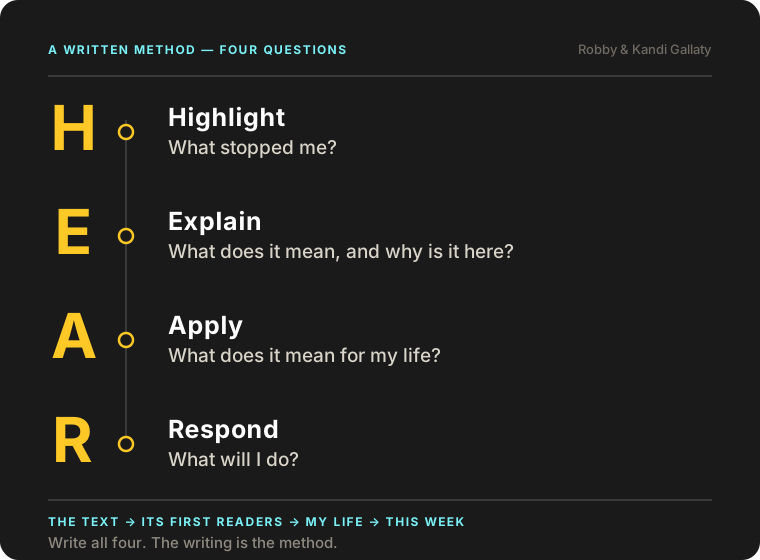
This is the working reference for the HEAR method: every question I could find for each of the four steps, in one place, so you can keep it open while you write.
If you want the argument for why any of this matters — and why the step that intimidates people is the one that frees them — that is in the overview. This page is the tool, not the case.
One warning before the lists. These are menus, not checklists. Pick one or two per step. Answering all of them turns a fifteen-minute practice into homework, and homework is the thing people quit in week three. Westover Church describe the goal as moving your time in God’s Word “from information to formation,” which is a good test: if you are filling in boxes, you have slid back to information.
Before you start
Pray. It is in the method, and it is the part most people drop first because it does not produce anything on the page.
Robby Gallaty prints Psalm 119:18 at the top of his own handout — “Open my eyes, that I may behold wondrous things out of your law.” That is the posture the whole thing runs on.
H — Highlight
Read the passage, then copy out the one or two verses that stopped you. Gallaty’s instruction is to write down the name of the book, the passage, and the chapter and verse numbers that especially speak to you — plus a short descriptive title, so the entry is findable a year later.
Most sources ask no questions here. These are the best I found, from Westover Church:
- Which verse or phrase stands out to me most?
- What caught my attention as I read this?
- Is there a word, command, promise, or idea I can’t move past?
- What feels emphasised or repeated?
E — Explain
Gallaty’s own framing is the part that gets lost in summaries. This step is where you “engage with the text and wrestle for its meaning,” by “prayerfully leaning on the help of the Holy Spirit.” It is not a research assignment.
Gallaty’s questions:
- Why was this written?
- To whom was it originally written?
- How does it fit with the verses before and after it?
- Why did the Holy Spirit include this passage in the book?
- What is He intending to communicate through this text?
Note that the last two are not answerable by study. They are asked and waited on.
Questions other churches add:
- What is the author saying to the original audience?
- What is happening in this passage?
- What does this passage reveal about God, humanity, or God’s plan?
- What are the keywords? What is repeated?
- What transition words are used, and why?
- When was this written, and what was life like then?
A translation with translator notes will answer most of the first group in under a minute. That is the whole step on an ordinary day.
A — Apply
Gallaty calls this “the heart of the process,” where everything else culminates. Write two to five sentences on how the text fits into your life.
Gallaty’s questions:
- How can this help me?
- What does this mean today?
- What would the application of this verse look like in my life?
- What is God saying to me?
- How will this passage change the way you think about God?
- How will this passage inform your practice as a Christian?
Sharper ones, from Westover:
- What is God inviting me to believe, do, or change?
- Is there a sin to confess, a truth to trust, or an action to take?
- How does this passage challenge my attitudes, habits, or priorities?
- What would obedience look like today or this week?
That last one is the most useful question on this entire page. “Today or this week” is what stops Apply drifting into a general observation about the Christian life.
R — Respond
A call to action, a description of how you will be different, something you are going to do, or a prayer written out. Gallaty’s instruction on the journal sheet is four words long: be specific, and carry it out.
- How do I want to respond to God based on what I have read?
- What do I need to confess, thank God for, or ask Him for?
- How can I express trust or surrender in light of this?
If your Respond could have been written before you read the passage, it is not a response. It is a sentiment.
Running it with other people
Everyone writes their own entry first, alone. Then compare Highlights before anyone explains anything — five people will usually have stopped at five different verses, and that tells you what is actually in the room.
Then do Explain together. This is the answer to the standard criticism of HEAR, which is that it can leave people dependent on one well-prepared leader to catch misreadings. A group wrestling with the same passage out loud corrects itself, and because everyone has written their reasoning down, the reasoning is visible instead of vague.
It works asynchronously too. Post your Highlight in a thread, come back for Explain. People who would never speak up in a room will type.
The template
Four headings. That is the whole format.
Date:              Passage:

H — the verse that stopped me (book, chapter, verse, short title)

E — what it means, and why it is here

A — what it means for my life (2–5 sentences)

R — what I am going to do
Attribution where it is due: the HEAR journaling method is Robby and Kandi Gallaty’s, and the questions in the first group of each section are theirs. Start with the overview if you have not read it, and the wider case for formation at a distance is in the guide on digital discipleship for churches.
This is part of the Digital Discipleship edge. The full guide is Digital discipleship for churches.